
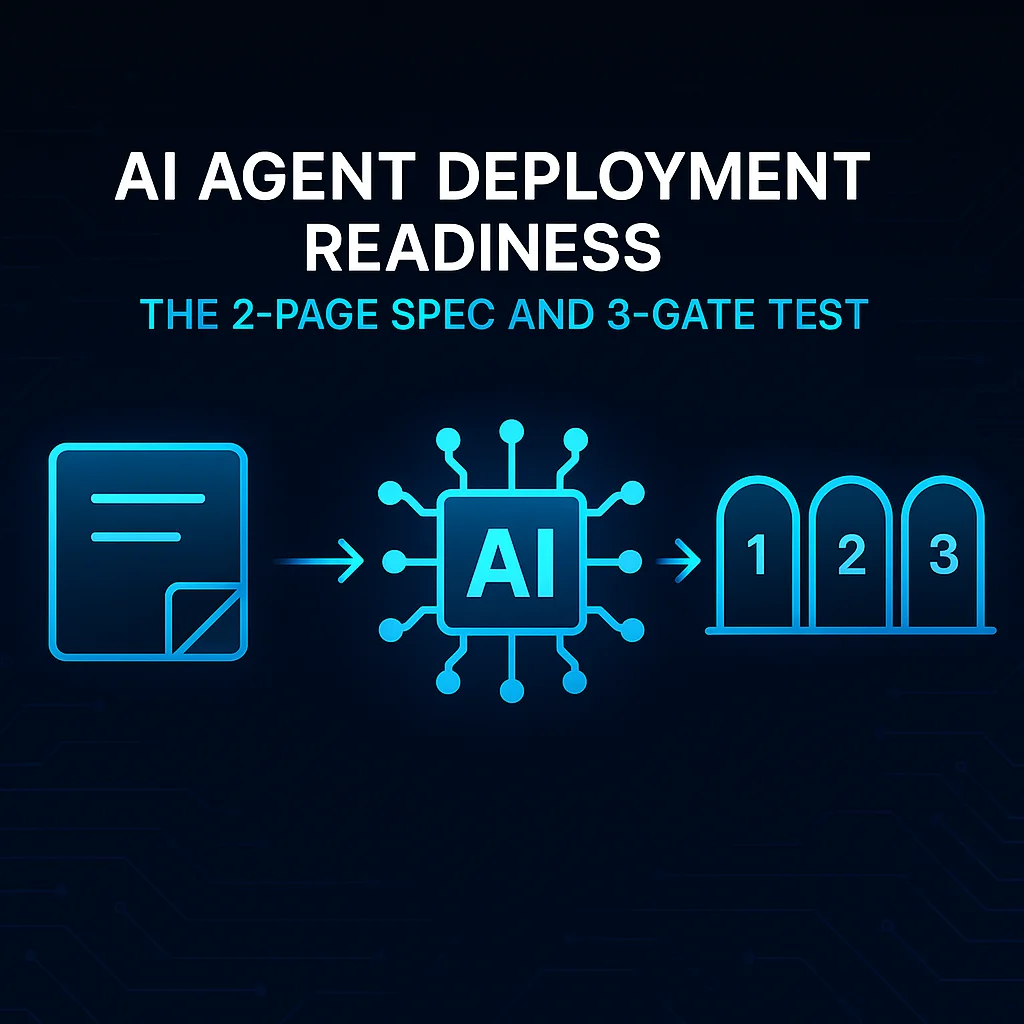
If you’re considering AI agent deployment readiness for your small business, you’re not alone. Many Midwest operators are drawn to time-saving automation—but most failed projects have one thing in common: unclear processes and missing readiness checks.
Before you invest in new tools or vendors, step back and ask:
Skimping on readiness is the top reason small businesses waste resources on AI agent projects that never deliver measurable value.
AI isn't a miracle plug-in—it’s a helper for workers, not a replacement. Start with what your team does today, not what you wish AI could do in theory.
One of the best ways to avoid wasted effort is creating a simple, two-page workflow specification for AI before even looking at software or agents. This document serves as a bridge, making sure the real-world process—not assumptions—drive your automation plan.
This brief, down-to-earth spec isn’t busywork. It lets you:
Even leading-edge teams building AI factories stress workflow specs, as StrongDM’s Software Factory model shows: specs and scenarios matter more than just tools.
Before AI deployment, successful businesses apply a 3-gate readiness test—no matter how tempting the tech looks. Each gate is a checkpoint that helps prevent downstream headaches. Here’s what to check:
Most operator discussions point to skipped readiness gates as the root cause of agent stalls—not lack of fancy technology.
Test your agent with a real, time-boxed pilot—usually 14 days—using a go/no-go checklist. Capture what worked, what broke, and where human guardrails were still required. This minimizes cost and keeps ‘scope creep’ in check.
For a detailed readiness audit and pilot structure, consider a proven framework like our AI Project Setup workflow, designed for small businesses. It builds guardrails in from Day One.
AI agent deployment isn't about copying Silicon Valley trends—it's about mapping out what already works and removing the manual drudge.
Midwest operators know every process has quirks. Capturing those is what makes AI useful—not perfect diagrams.
Local knowledge is key. That’s why our approach at Expert AI Services emphasizes Kansas and Midwest experience—keeping AI grounded in reality, not fantasy.
Plenty of vendors promise easy AI agent deployment, but few offer transparency about workflow specification for AI, or readiness safeguards. Before you sign a contract, look for:
For context, even large vendors are grappling with cost and scaling risk. TechCrunch’s recent reporting on OpenAI’s agent pricing shows that pilots and readiness audits aren’t just “small business” issues—they’re universal.
Even with the right checklist, small businesses can trip on recurring mistakes. Look out for these traps:
Pro tip: The most successful automations are grounded in real, lived workflows—not idealized diagrams or wishful thinking.
The path to successful AI agent deployment readiness isn’t about chasing trends—it’s mapping what works, documenting it, and building in checks. Start with your 2-page workflow spec and 3-gate readiness test; demand vendors (and consultants) can work from your process, not the other way around.
Ready to bring real-world AI to your team? Explore practical examples—from SMS-based AI assistants to blueprint extraction—tailored for Midwest industry at our AI Project Setup page.
Difficulty Level
Intermediate
Action Item
Draft a 2-page workflow spec and apply the 3-gate readiness test before deploying any AI agent.
Tools Mentioned
No specific software tools, general AI agent frameworks
Time to Implement
2-4 hours