
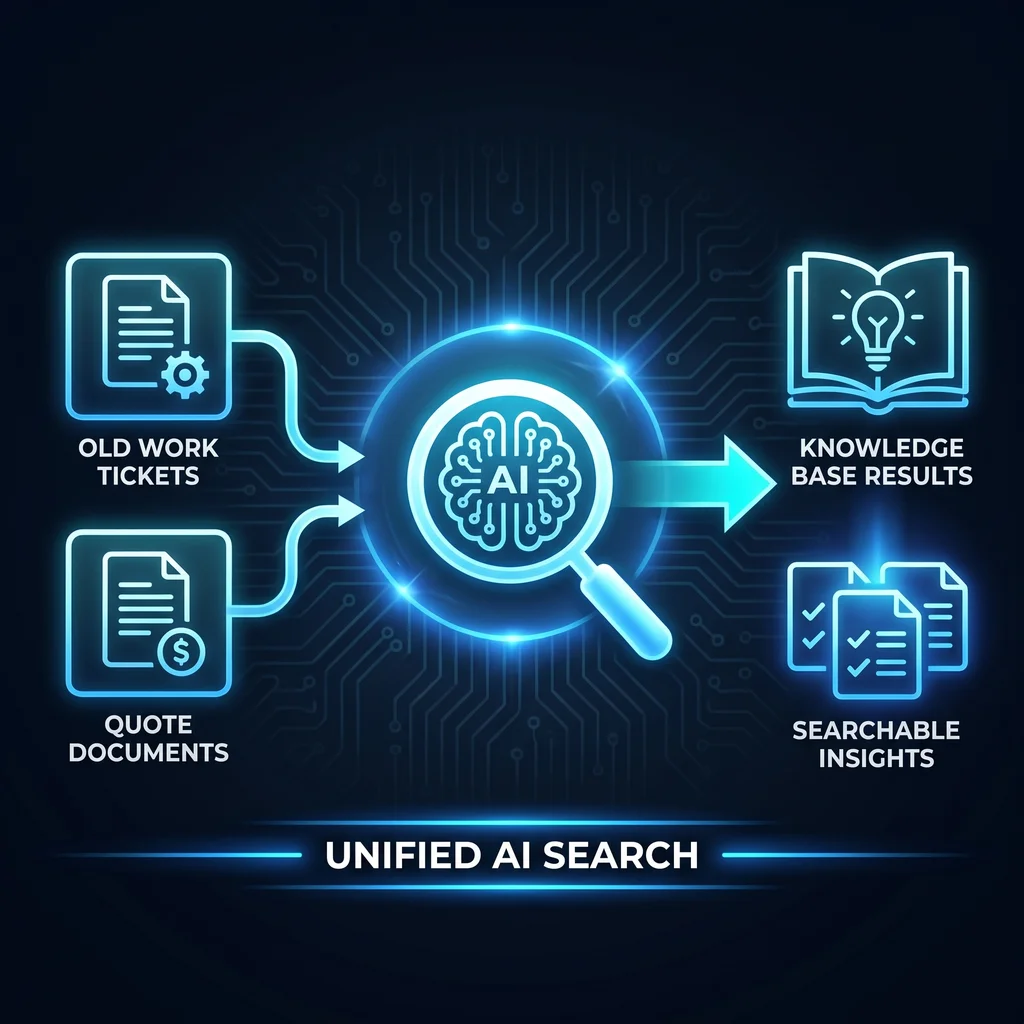
A packaging business does not need a futuristic AI project to feel the pain of scattered information. The issue usually starts smaller: years of Excel work tickets, Word quotation files, shared folders, old customer notes, and a few experienced employees who know where the useful examples are hiding.
That history matters. Old tickets can show how a similar job was handled. Past quotes can help a coordinator understand what was included, what was excluded, and how a customer normally describes their needs. But when the files are hard to search, the team either spends time digging or starts from scratch.
This case-study scenario is built around a practical question: what would it look like for a packaging business to turn old work tickets and quote documents into a searchable knowledge base?
Most small businesses do not lose knowledge all at once. It gets buried slowly. A quote is saved under a customer name in one folder. A work ticket is stored by date somewhere else. A revised version lives in email. An employee remembers that a similar job happened last year, but not the exact filename.
That creates real drag for owners and operators. The team may need to quote repeat work, answer a customer question, review a prior job, or compare a new request with an old one. If the information is difficult to retrieve, staff lose time looking through documents instead of doing the work that moves the order forward.
For this type of project, the first goal should not be full automation. The better first step is reliable retrieval. Can the team ask a plain-English question and get back the most relevant old tickets, quote files, file names, and short summaries? Can they see where the answer came from before trusting it?
That boundary is important. AI search should help experienced staff find prior work faster. It should not quietly change quotes, send customer-facing messages, or make pricing decisions without review. The workflow earns trust by staying inside a clear lane: find, summarize, cite the source file, and hand the decision back to the person responsible for the work.
For a working business, the best first AI win is often not a brand-new system. It is making the records the team already owns easier to find and use.
A practical knowledge base would start by collecting the historical Excel and Word files into a controlled document set. The system would read the files, extract useful text, preserve available metadata, and create a search layer that supports plain-English questions.
A coordinator might ask for prior jobs involving a similar packaging request, a past quote with comparable scope, or old work tied to a repeat customer. The AI agent would return a short answer, relevant document references, and enough context for the employee to open the original file.
That source visibility keeps the workflow grounded. If the old record is incomplete, the system should not pretend otherwise. If several files might match, it should show the strongest candidates and let the employee decide which one applies.
AI document search works best when the business also does some cleanup. That does not mean every file has to be perfect. It does mean the project should identify duplicate folders, obsolete versions, sensitive documents, and permission boundaries before the search experience goes live.
This is where a model-agnostic stack can help. The business should not be trapped into one tool just because it was fashionable when the project began. The workflow should be designed around the company’s files, permissions, and day-to-day use cases.
The key guardrails are file permissions, source visibility, and human review. A staff member should only search the records they are allowed to see. Every answer should point back to the source document. Any customer-facing action should remain under human approval unless the owner deliberately scopes a later automation step.
This is especially important for Kansas businesses that run on practical relationships and repeat trust. A packaging company may have years of customer history inside old quote language, notes, and internal documents. Custom AI services should respect that history. The goal is less software, more useful workflows.
Expert AI Services brings that kind of practical lens from real operations and building-systems experience. The team’s background in controls, BAS, low-voltage work, and field coordination shapes how it approaches AI: useful tools, clear handoffs, and respect for the people keeping the business moving. Learn more about that local background on the Expert AI Services about page.
Before building, the first step would be scoping. What files need to be searched? Where are they stored? Who should have access? What questions do staff actually ask? What should the AI answer directly, and what should it only summarize for review?
A document intelligence workflow may also connect with applied tools like DWG-Extract, which reflects the same principle in a different setting: use AI to pull useful structure from documents so teams can move faster without losing control of the work.
For a packaging business, the payoff is not hype. It is fewer wasted searches, faster access to old examples, and better coordination between the people who quote, schedule, produce, and support the work. AI simplifies the record hunt. It does not replace the judgment of the people who know the customers and the jobs.
If your team has years of tickets, quotes, spreadsheets, and document history that should be easier to use, Expert AI Services can help scope the next practical step. Talk with an AI integration lead about a narrow search workflow that fits the way your business already runs.
Client Type
The Problem
The Solution
Result
Result
Result
Conclusion