
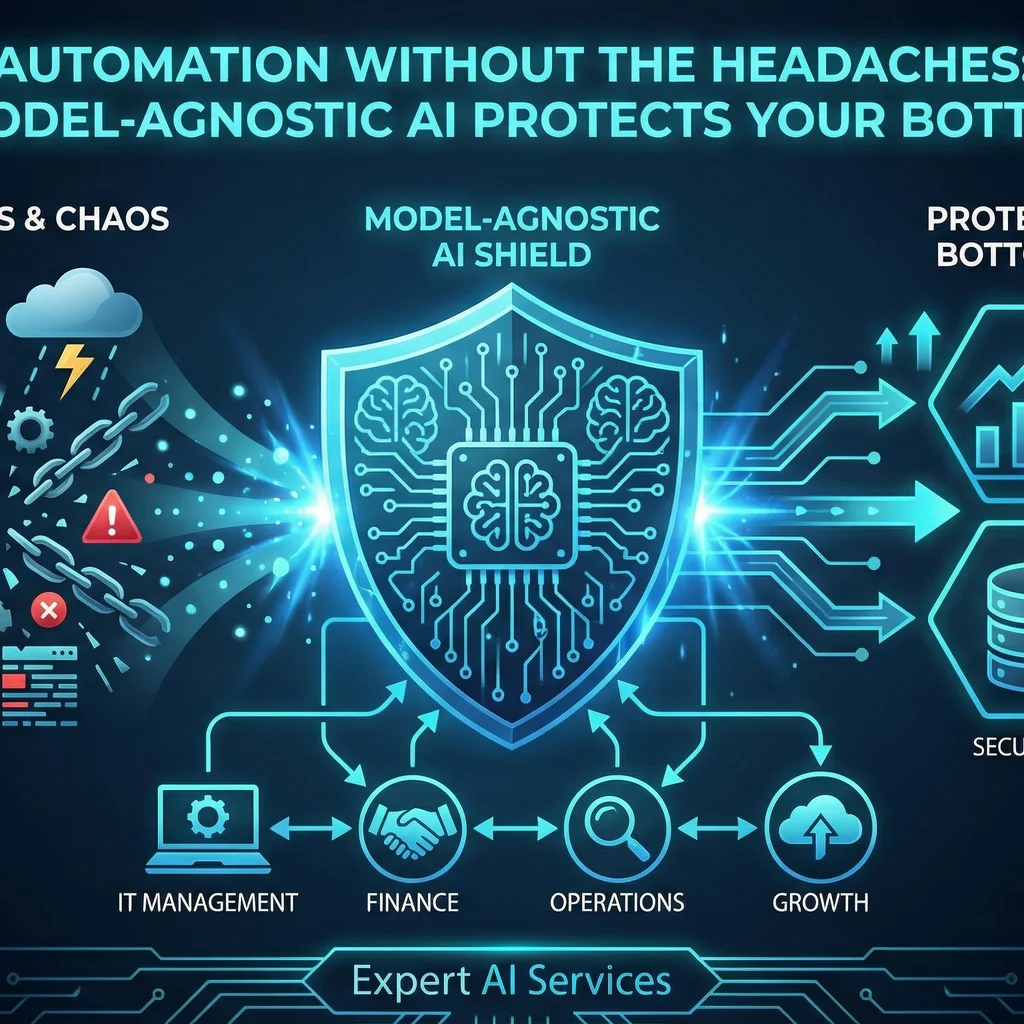
Model-agnostic AI automation gives small businesses a way out of the headache-inducing cycle of vendor lock-in and unpredictable price hikes. By designing systems that can route tasks to the best-value AI model at any given moment, you get flexibility and control that single-provider solutions simply can’t match. That’s why model-agnostic AI automation sits at the center of every future-proof strategy for business process automation and cost savings.
Key takeaway: A model-agnostic approach insulates your business from unexpected provider price hikes and keeps you adaptive in a fast-changing market.
Small business owners are lured by promises of efficiency, only to find that rigid automation systems can become a budgetary trap. Most out-of-the-box solutions lock you into proprietary workflows or a single AI provider. If those costs double overnight—as in cases like Cursor's AWS and Anthropic expenses—your margin vanishes and your options are limited.
Cursor's costs exploded from $6.19M to $12.67M in just a month with Anthropic's new service tier. Learn more
Vendor lock-in is one of the biggest threats to AI ROI. Many AI providers make it easy to start but hard to leave, as pointed out by CTO Magazine’s strategy guide. Once your workflow, data, and team are invested in one vendor’s architecture, switching providers becomes a costly, complex project.
According to Airia’s business case for model-agnostic AI, flexible model selection is a direct line to long-term cost control.
Small business budgets don’t allow for the massive overruns seen at enterprise scale. Take Cursor’s example: spending $650M/year on Anthropic, with only $500M in revenue—a negative margin that would be fatal for most small businesses.
Our approach focuses on model-agnostic integration—systems that route work to OpenAI, Anthropic, or open-source models as your needs, or the market, shift. This adaptability is what keeps automation sustainable for growing businesses.
"Flexibility is the strongest defense against AI cost explosions. Businesses that build provider-agnostic pipelines can respond instantly to price or capability changes—without rebuilding their automation from scratch."
Staying on top of automation cost savings isn’t just about reducing spend—it’s about controlling risk and making sure automation investments actually deliver business value. A Deloitte analysis outlines a 'pivot to tokenomics' for controlling AI spend, emphasizing flexibility over fixed contracts. Real-world automation ROI emerges when businesses:
{
  "task": "customer support reply",
  "models": [
    { "provider": "OpenAI", "cost": 0.0025, "latency": 1.4 },
    { "provider": "Anthropic", "cost": 0.004, "latency": 1.1 },
    { "provider": "Llama-3", "cost": 0.001, "latency": 1.7 }
  ]
}
This example shows how a model-agnostic system can compare real-time pricing and performance, and route each request for maximum savings and quality.
Pro tip: Routinely benchmark AI models and negotiate with providers—model-agnostic tools make this easy and create leverage.
Even if your business isn’t ready for advanced orchestration, the path to future-proof automation starts with a few practical steps:
AI is moving faster than any single vendor or model can keep up. Avoiding expensive dead ends means building in flexibility from day one. As new models like Llama-3, DeepSeek, or agent-based architectures arrive, model-agnostic automation lets you quickly evaluate and leverage the latest advancements, whether they come from enterprise giants or nimble open-source communities.
Future-proof automation isn’t about guessing tomorrow’s winner—it’s about giving your business the power to choose, adapt, and scale with confidence.
For Midwest businesses especially, this approach means you don’t have to chase Silicon Valley trends to benefit from world-class automation. Our philosophy: AI simplifies, it doesn’t replace. We’ve seen it firsthand across industries—when you focus on flexibility and cost control, automation headaches disappear.
Rethink Your Automation Strategy: If you're ready to protect your margin and future-proof your operations, talk with an AI integration lead who understands both your industry and the realities of model-agnostic automation. Reach out today to get started.
Process Type
Business Process Automation
Time Saved
Varies (risk of sudden overruns avoided; proactive control)
Tools Used
OpenAI, Anthropic, Llama-3, internal workflow automation tools
Before
Automation tied to a single AI provider; sudden cost increases jeopardize margins; rigid systems unable to adapt.
After
Model-agnostic automation routes tasks to the most cost-effective AI, allows rapid provider changes, and delivers sustainable cost control.