
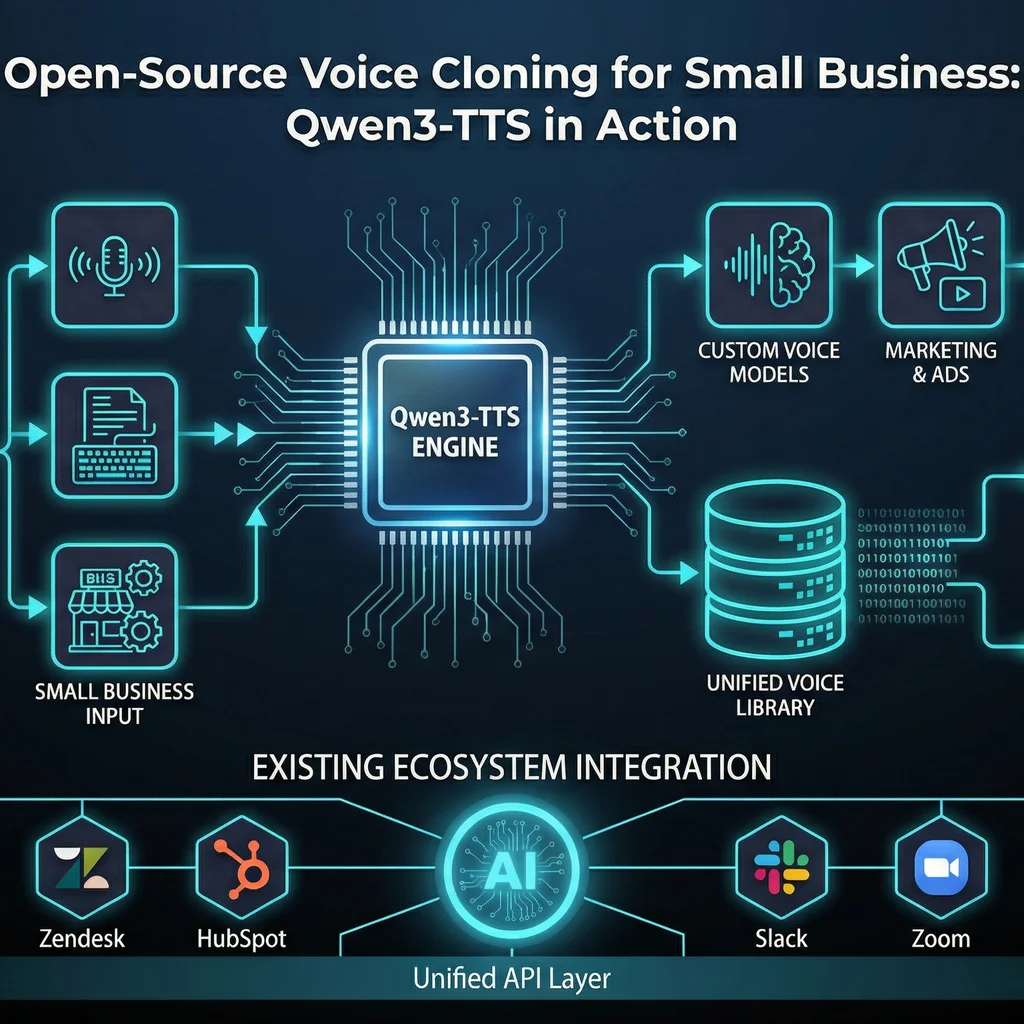
Open-source voice cloning for small business is reshaping how local companies create content, connect with customers, and differentiate their brand. For years, professional audio for marketing meant hiring voice talent or signing up for expensive text-to-speech (TTS) subscriptions. Now, tools like Qwen3-TTS put affordable, high-quality AI voice technology in reach for a new generation of operators.
Imagine generating customized voiceovers for ads, explainer videos, podcasts, IVRs, and announcement systems—all with a consistent brand sound and no ongoing fees. For Midwest SMBs competing for attention online, this unlocks significant competitive advantages. Consistent, authentic audio is suddenly accessible—wherever you operate.
"What used to require a paid subscription and cloud API can now be downloaded and run locally, completely free, with no usage limits."
Historically, creating professional audio content posed a steep challenge for small businesses. The options:
Commercial TTS solutions like ElevenLabs promise high fidelity but come with monthly bills ranging from $5 to $99+, usage caps, and the need for internet connectivity. These expenses stack up, especially for organizations that produce frequent or multilingual content.
Small businesses face a clear barrier: high costs, time delays, and complex licensing limit the creative agility needed to grow market share.
Outsourcing audio fragments your brand voice, while commercial libraries may lack the tone and emotion your audience expects. Local identity often gets lost in translation—literally—when scaling to multi-language markets.
The rise of open-source TTS solutions like Qwen3-TTS marks a turning point for small business innovation. We selected Qwen3-TTS for its unique blend of affordability, flexibility, and control—qualities essential for companies unwilling to sacrifice brand identity or overspend on recurring licensing.
These features align closely with model-agnostic best practices recommended by industry analysts. As Airia's business case for model-agnostic AI highlights, the ability to freely swap models without lock-in lets companies continuously optimize for cost, performance, or compliance.
Qwen3-TTS opens up a toolkit once reserved for large enterprises, allowing small businesses to compete on both quality and agility.
We approached the implementation as a staged integration, prioritizing business value while protecting existing workflows. Here’s how we brought Qwen3-TTS from proof-of-concept to production:
qwen3-tts-base for fast playback, qwen3-tts-large for highest realism).python generate.py --input script.txt --voice sample.wav --lang en --out marketing-voiceover.wavPro Tip: Maintaining a local set of voice samples ensures control and flexibility for future campaigns, even if AI models evolve or regulatory needs shift.
Since deploying Qwen3-TTS, we've observed a significant improvement in both workflow efficiency and marketing output quality. Processes that once took days to coordinate now happen on-demand, directly from the desktop. There are no per-minute charges and no limits on project size.
These gains match what leading analysts project for model-agnostic AI solutions. As CTO Magazine’s coverage of AI vendor lock-in notes, owning your tools and data builds strategic flexibility as AI evolves.
With open-source voice automation, small businesses reclaim control and unlock new opportunities for customer engagement—without the risk of vendor lock-in or runaway costs.
For broader workflow transformation ideas, our AI project framework details how to plan, evaluate, and execute scalable automation based on real operational needs.
Open-source voice cloning goes beyond cost savings—it brings measurable brand and relationship gains:
With Qwen3-TTS, a single recording powers campaigns in 10 languages, all while retaining your unique tone and professionalism. For operators across the Midwest, this is pivotal as customer bases diversify and digital touchpoints expand.
Voice automation lets each customer interaction feel distinctly personal—no matter the channel or language.
If you're interested in how model-agnostic AI strategies can deliver on both automation and authenticity, the services hub explores modern best practices for AI adoption without locking you into pricey vendor contracts.
The Qwen3-TTS case has shown that small businesses can now access the same AI-powered audio tools once exclusive to global enterprises—while retaining full control over their brand.
Key Takeaway: Open-source voice cloning is a strategic equalizer, empowering SMBs to automate, personalize, and compete—on their own terms.
Ready to explore how AI voice automation and model-agnostic AI can drive your Midwest business forward? Our experienced, local team has guided dozens of businesses through AI project kickoff and deployment—always prioritizing operational simplicity and long-term value. Let’s help you unlock the same results.
Wondering what open-source voice automation could achieve for your marketing, customer experience, or training workflows? Connect with an AI integration lead for a practical, jargon-free discussion—and actionable next steps tailored to your industry.
Talk to an AI Integration LeadClient Type
Expert AI Services (internal deployment)
The Problem
Recurring costs and complexity producing professional, consistent audio content for marketing and operations.
The Solution
Implemented open-source Qwen3-TTS for local, vendor-independent, multilingual voice automation.
Result
Reduced production time from days to hours for audio content.
Result
Eliminated ongoing subscription costs, allowing budget reinvestment.
Result
Achieved consistent, on-brand audio across multiple channels in 10 languages.
Conclusion
Key Takeaway: Open-source voice cloning is a strategic equalizer, empowering SMBs to automate, personalize, and compete—on their own terms.