
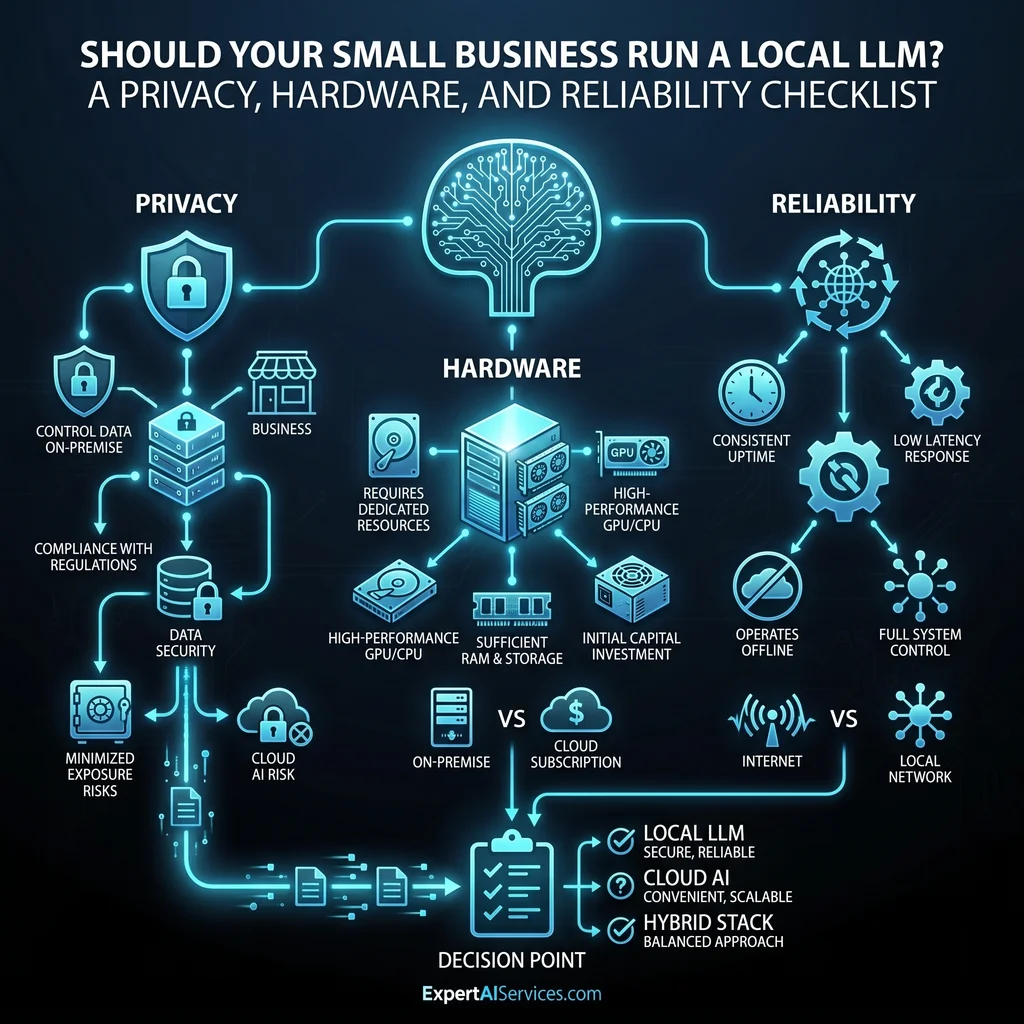
If you are asking whether a local LLM for small business belongs in your AI plans, start with the workflow, not the hardware. Hosted AI can be fast, capable, and easier to support. Local AI can give you more control over sensitive data, reduce dependence on a steady internet connection, and help when strict data-handling rules are part of the job. The right answer depends on privacy, uptime expectations, technical support capacity, and the work you are trying to automate.
A local large language model runs on equipment you control, such as a workstation, server, or private on-prem setup. That sounds simple until the business has to maintain it. The appeal is real: private prompts, local files, fewer vendor decisions, and more control over how data moves. Open-source projects such as the OpenHuman local AI project on GitHub show the momentum around AI that can run outside a fully hosted vendor stack.
That momentum does not mean every contractor, manufacturer, professional office, or service company should self-host a model next month. A local model is not a shortcut around planning. It is infrastructure. If the workflow is not clearly defined, the users are not trained, or no one owns support, the system can become one more tool people work around.
Run AI where the work belongs: hosted when speed and breadth matter, local when control matters, and hybrid when the business needs both.
Before asking should my business run AI locally, ask what the AI will touch. Will it read customer records, payroll details, service notes, drawings, proposals, inspection reports, or internal pricing? Can that data leave your environment under your current agreements? Can it be redacted before use? Who needs to review outputs before they reach a customer or technician?
This is the heart of a small business AI privacy checklist. If the data is low-risk and the task is routine, a hosted model may be the practical choice. If the workflow involves sensitive documents, strict data-control expectations, or a customer promise that files stay inside your environment, on-prem AI for SMB privacy may be worth evaluating.
AI hardware requirements for business are more than a fast machine. You need enough compute for the model, enough memory for the context, storage for files and logs, secure access controls, and a plan for updates. Then come the less visible costs: backups, monitoring, model version changes, security patches, permission management, and help for the person who cannot get the tool to answer correctly at 4:30 on a Friday.
A local model can help when internet service is unreliable, but local hardware can fail too. If the AI supports estimating, customer response, field coordination, or document review, the business needs a fallback. That may be a manual process, a hosted backup model, or a queue that pauses work until the local system is restored. Local AI without a recovery plan is not a reliability strategy.
For small teams, the biggest question is often not whether the model can run. It is whether someone can keep it running. If your IT lead is already handling phones, printers, line-of-business software, cybersecurity issues, and user support, adding local AI infrastructure should be treated as real operational work.
The most practical answer is often hybrid. Hosted vs local AI models should be a routing decision, not a loyalty test. Routine drafting, general research support, and low-risk internal summaries may fit hosted tools. Sensitive document extraction, private job notes, or internal knowledge search may fit local or tightly controlled infrastructure. High-value tasks may deserve whichever provider performs best for that workflow.
This is where a model agnostic AI stack matters. Vendor lock-in is a real planning concern, and CTO Magazine outlines AI vendor lock-in as a strategic issue. A model-agnostic approach lets a business route work by cost, privacy, performance, and reliability instead of rebuilding everything when one provider changes pricing or capability. Airia describes the business case for flexible model selection in model-agnostic AI platforms, and TrueFoundry discusses AI model gateway architecture for vendor lock-in prevention.
Expert AI Services looks at this decision through the lens of real operations: controls, BAS, low-voltage work, field coordination, documents, handoffs, and the daily software clutter that slows teams down. The goal is not more AI for its own sake. The goal is less software, more useful workflows, and AI agents that help people finish the work already on their plate.
If you are early in the decision, start with the local Expert AI Services team and how they think about applied AI for Kansas and Midwest businesses. If document-heavy work is part of the challenge, review DWG-Extract as an example of turning complex files into usable workflow support.
A local LLM can be the right move when privacy, data control, internet reliability, or customer requirements justify the extra burden. It can also be the wrong move if the business is not ready to maintain hardware, patch systems, support users, and plan for downtime. Start with one workflow, define the data risk, decide what must stay local, and keep the stack flexible enough to use the best model for the job. That is how small businesses get useful AI without taking on infrastructure they are not ready to own.
Difficulty Level
Action Item
Tools Mentioned
Time to Implement