
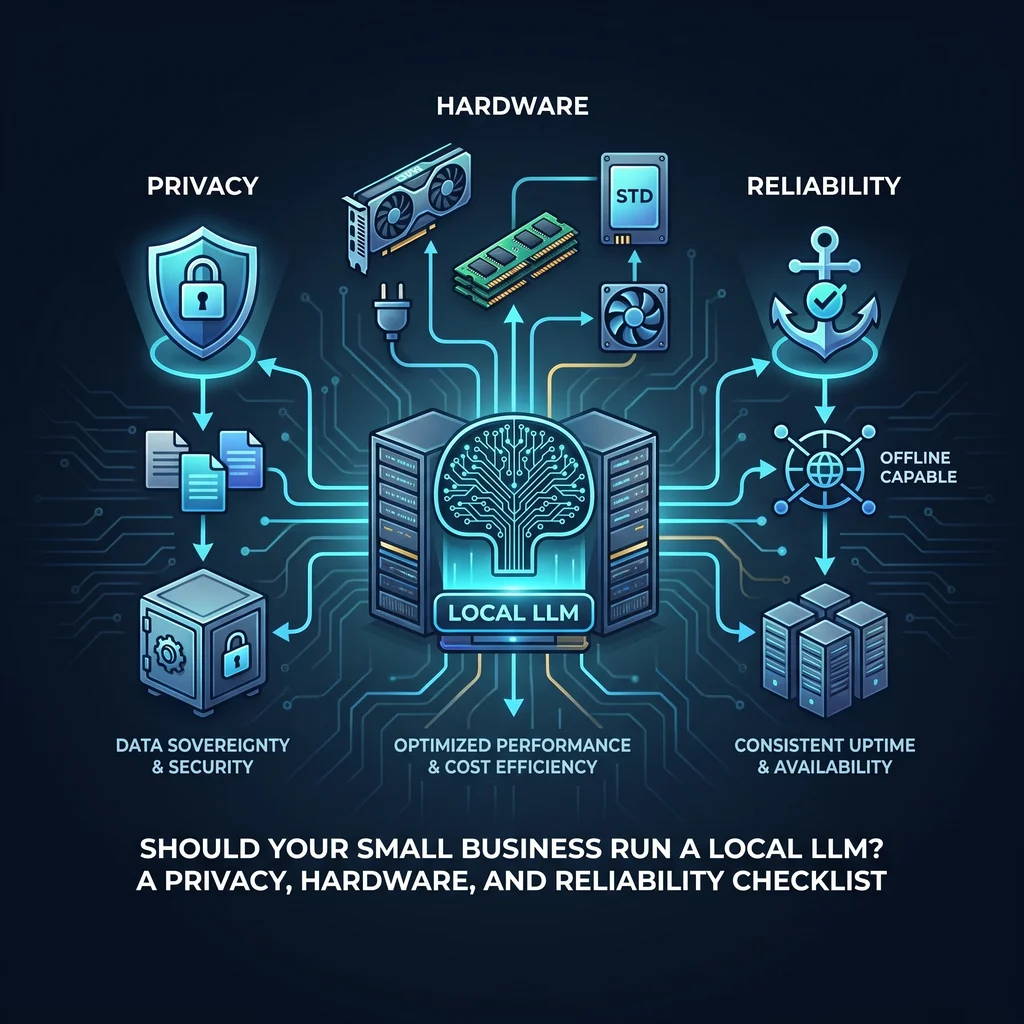
Local LLM for Small Business: A Privacy, Hardware, and
A local LLM for small business can be the right move, but only when the privacy, access-control, hardware, backup, and maintenance realities line up with the work. For a Kansas contractor, clinic office, distributor, manufacturer, or service company, the question is not whether local AI sounds advanced. The question is whether owning that AI system will make the business more reliable, more secure, and easier to run.
AI tools are landing on small-business desks quickly. Entrepreneur's roundup of AI tools for solopreneurs shows how broad the tool conversation has become. That does not mean every company needs a server in the back room. It means owners need a grounded way to decide what belongs in the cloud, what belongs locally, and what should move between both.
Local LLM for Small Business: Start With Privacy, Not Hardware
The best first step is a simple AI privacy checklist. What business documents will the model read? Are they customer records, pricing files, HR notes, vendor contracts, building drawings, service logs, or internal procedures? Who should be allowed to ask questions against those documents? Should answers be logged? Should certain staff see only certain folders?
If your team is asking, should my business run a local AI model, the strongest reason is usually control. Private AI for business documents may matter when files cannot leave a managed environment or when permissions must mirror the way your company already protects records. Even then, local is not automatic. A well-configured cloud tool with proper access controls may be enough for many workflows.
Before buying AI hardware, decide what data must stay private, who can use it, and who is accountable when the system is wrong or offline.
Cloud vs Local AI for Small Business
Cloud AI is often easier to launch. The provider handles most infrastructure, scaling, patches, and model updates. That can be a strong fit for marketing drafts, general research, meeting summaries, intake triage, or routine workflow automation where the data risk is manageable and the business needs speed.
Local AI can be useful when the business wants tighter control over where documents are processed, how access is granted, and how long records are retained. But the tradeoff is ownership. Local systems need hardware sizing, storage, backups, monitoring, updates, and someone who knows what to do when a drive fails, a model update breaks a workflow, or performance slows during a busy week.
Hybrid AI is often the practical answer. Sensitive document search can run locally, while lower-risk tasks use cloud models. A model agnostic AI stack helps route work based on privacy, cost, reliability, and quality instead of forcing every task through one vendor. That matters because CTO Magazine's vendor lock-in strategy coverage points to a real planning concern: businesses need room to change providers as needs and model quality shift.
The On-Prem AI Checklist for SMB Teams
Use this on-prem AI checklist for SMB planning before a purchase order gets signed.
Privacy and permissions
List the document types the AI will touch. Mark which are public, internal, confidential, or regulated by contract. Then map staff roles to access. The office manager may need invoices and scheduling notes. A technician may need manuals and service history. A sales lead may need proposals but not HR files. Local AI does not solve permissions by itself. It still needs clean rules.
Hardware and recovery
Local AI hardware requirements depend on model size, document volume, response-time expectations, and how many people will use the system at once. The practical questions are plain: where will it run, how will it be backed up, how quickly can it be restored, and who checks that it is healthy? If the business cannot tolerate downtime, the recovery plan matters as much as the model.
Maintenance ownership
Somebody has to own updates, monitoring, user changes, failed jobs, security reviews, and quality checks. That may be an internal technical lead, an outside IT partner, or an AI integration partner. If responsibility is vague, the system will drift. Midwest businesses know this from controls, BAS, low-voltage, and field coordination work: reliable systems need clear ownership after installation.
Where a Model-Agnostic Stack Helps
A model-agnostic stack keeps the business from being boxed into one provider or one deployment pattern. Some workflows need local processing. Some are fine in the cloud. Some should use whichever model performs best at the right cost. Airia's business case for model-agnostic AI platforms supports this flexible model-selection approach.
There is also visible experimentation around private and local AI. For example, the openhuman GitHub project is useful trend context for local AI interest, though it should not be treated as a production recommendation for a small business. Production systems need support plans, testing, permissions, and a realistic maintenance model.
Expert AI Services approaches this from applied operations, not novelty. Our team has roots in building systems, controls, BAS, low-voltage work, and the coordination problems that show up when software does not match how people actually work. You can learn more about that local, field-tested perspective on our about page.
A Practical Decision Before You Buy
If you are still deciding, write down the workflows first. For each one, mark the data sensitivity, user roles, uptime need, expected volume, and acceptable monthly cost. Then decide whether the work should be cloud, local, or hybrid. This is where custom AI services should simplify the business, not add another tool nobody has time to maintain.
For document-heavy workflows, look at proven patterns before building from scratch. Our DWG-Extract work shows how applied AI can turn technical documents into more usable operational information without pretending one model fits every job.
The right answer may be local. It may be cloud. It may be both. What matters is that the choice is tied to privacy, reliability, hardware, staff permissions, and maintenance ownership. Decide those first, and the model decision gets much clearer.