
Ask any Midwest small business owner about their least favorite weekly job, and you'll hear the same answer: reports. Whether for marketing outreach, operations updates, or compliance check-ins, the task always seems to pile up. For years, our example Kansas business—like many others—relied solely on manual work to get these weekly marketing and operations reports out the door. Receipts are scanned, spreadsheets triple-checked, numbers copied from one system to another, and updates given to teams running routes between towns.
Small business reporting automation felt out of reach, either too expensive or too confusing to prioritize. The team figured, 'We do it by hand, so it always gets done.' Except, over time, it started costing them dearly—in lost hours and delayed decisions.
One operator's workflow on Reddit reported saving 10 hours per week with a structured, repeatable reporting pipeline, showing just how much time small businesses can win back with the right approach.
Manual reporting isn't just inconvenient—it quietly drains both time and morale. Owners and operators across Kansas and the Midwest find themselves working after hours, tracking down missing receipts, and reassembling fragmented data just to keep stakeholders informed.
Automation promised a fix, but most off-the-shelf AI tools either require too much technical know-how or operate as black boxes. Fully autonomous reporting solutions—marketed everywhere these days—often fail in subtle ways, missing key nuances in the data or creating silent errors that nobody catches until it's a problem.
Many small businesses have learned the hard way: trusting a 'set it and forget it' AI can mean flying blind when things break on Monday morning.
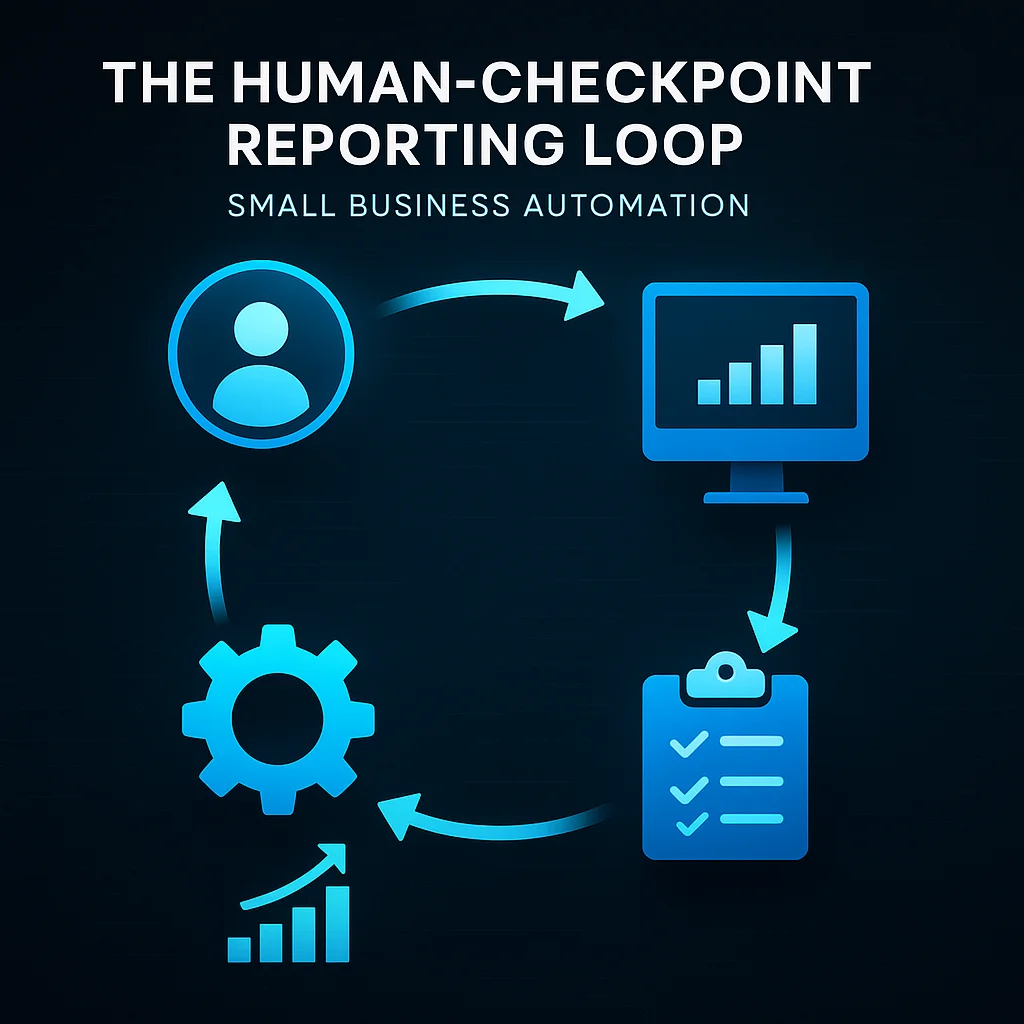
Enter the human-checkpoint reporting loop—a five-stage workflow tailor-made for bounded automation in small businesses. It bridges manual diligence with AI-driven efficiency, giving owners control and peace of mind.
This pattern is "the missing governance layer between 'I tried AI automation' and 'it runs reliably every week.'" It maintains speed while ensuring mistakes don't slip through.
Real-world Reddit workflows (like those discussed in r/ClaudeAI) and open-source projects such as StrongDM's Software Factory validate this approach. Operators everywhere are combining automation with human checkpoints to keep reporting reliable and actionable for their teams.
After adopting the human-checkpoint loop, the Kansas team's week looked different almost immediately.
Perhaps the biggest practical win: no more mystery failures. The human sign-off ensures that every marketing or operations report actually goes out on schedule and with accurate data. This isn't "disruption for the sake of buzz"—it's pragmatic time-saving business automation.
Time saved doesn't just show up on a timesheet—it improves coordination, burns fewer resources, and lets owners focus on growing their business instead of babysitting software.
Today, our example business isn't worried about dropping the ball on reports. Marketing and operations updates are consistent, actionable, and easy to trace. Team morale is higher with less grunt work and fewer last-minute scrambles.
Key Takeaway: Combining AI-driven automation with simple human checkpoints is the sweet spot for operational efficiency in Midwest small business reporting. SMBs need reliability, not just novelty.
Not every solution fits right out of the box. For small businesses across Kansas and the Midwest, the balance between automation and operator sign-off is what builds trust and ensures repeatable wins.
If your team spends more time on reports than actually acting on them, consider piloting your own human-checkpoint loop. You don’t need a $10,000/month enterprise AI stack (TechCrunch’s recent coverage makes clear that’s out of reach for most small businesses). Instead, focus on the five steps outlined here—starting small, keeping operators in control, and choosing tools that mix automation with review.
Our company, Expert AI Services, helps Midwest businesses design these workflows so they work every single week and match your reporting needs—not someone else's template. If you want to understand how model-agnostic, human-in-the-loop reporting can work for your marketing or operations team, learn more about our local roots and field-proven expertise.
Ready to reclaim your time and bring reliability to your critical business reporting? Let’s start mapping your first reporting loop together.
Client Type
Midwest small business (Kansas operations team)
The Problem
Manual marketing and operations reporting draining up to 10 hours/week, high error risk, and delayed decision-making.
The Solution
Implemented a five-stage human-checkpoint reporting loop (connector, unified data sheet, AI analysis, human sign-off, scheduled delivery) for reliable, AI-assisted report automation.
Result
Saved a full workday each week previously lost to manual report prep.
Result
Reduced reporting errors and improved trust through operator sign-off.
Result
Enabled more consistent, actionable business decisions and less staff burnout.
Conclusion
Key Takeaway: Combining AI-driven automation with simple human checkpoints is the sweet spot for operational efficiency in Midwest small business reporting. SMBs need reliability, not just novelty.