
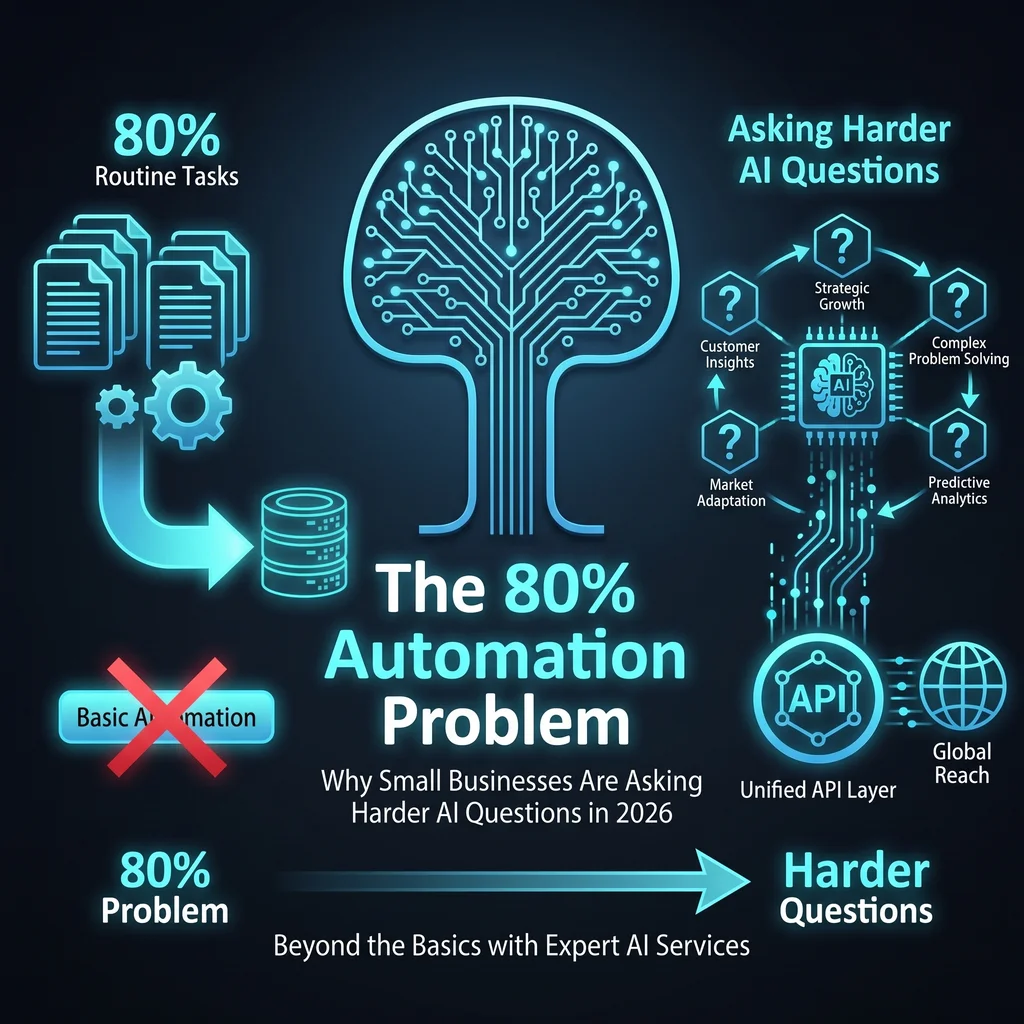
For a Kansas business owner, a workflow that works most of the time can still be a problem. The first AI demo may look useful: it drafts a reply, pulls a detail from a document, or summarizes a service note. Then real operations show up. A customer changes the request halfway through. A technician adds shorthand that only the team understands. A supplier sends a substitute part. The automation still helps, but it also creates a new question: who checks the work when the easy cases are gone?
That is the 80% automation problem. The phrase is not a formal benchmark. It is a useful way to describe a common small-business pattern: AI handles the obvious work, then leaves a costly review burden around exceptions, permissions, timing, and customer promises. In 2026, that is why owners are asking harder questions. They are not asking only what AI can do. They are asking whether the workflow will hold up when staff, customers, deadlines, and messy data are involved.
Partial automation can be valuable, but it has to be honest. If an AI agent drafts ten customer responses and two require careful repair, the owner needs to know whether the review time is still better than writing from scratch. If an extraction tool reads standard PDFs but struggles with scanned drawings, the team needs a clear fallback. If a follow-up sequence runs without context, it may save clicks while creating awkward handoffs for the person who owns the relationship.
In a contractor, distributor, clinic, shop, or service business, the first 80% is often the clean path: classify an email, draft a status update, copy a number from a form, or remind someone about an open quote. The last 20% is where the business actually earns trust. It includes unclear job history, inconsistent filenames, old customer notes, urgent callbacks, and exceptions that live in a coordinator's memory.
That hidden layer is why automation should be judged by outcomes, not by a polished demo. A useful AI workflow reduces manual logging, removes software clutter, and improves coordination. A weak one simply shifts work from doing the task to checking the task.
The broader AI conversation is moving in the same direction. In remarks published by Anthropic on May 25, 2026, co-founder Chris Olah argued that AI questions are bigger than computer science because they involve how systems interact with people, incentives, and society. For small businesses, that point lands in plain operational terms: who is accountable, what is the system allowed to touch, and how do people catch mistakes before they become customer problems? The source is available from Anthropic's publication of Olah's remarks.
The practical question is not whether AI can do a task once. It is whether the workflow stays useful when the easy cases are gone.
The last 20% hides in edge cases. It is the PO number that changed after the quote was drafted. It is the drawing note that conflicts with the email. It is the technician who knows a customer prefers a phone call before any schedule change. It is the supplier substitution that looks acceptable in a spreadsheet but creates a field issue next week.
AI agents can help with those moments, but only when they have boundaries. They need clear inputs, approved actions, logging, escalation paths, and permission limits. For Kansas companies used to controls, BAS, low-voltage work, field coordination, and jobsite accountability, this should feel familiar. The system is only useful when the handoff is designed.
Before buying or building another tool, write down the workflow in plain language. What starts the process? Which data is trusted? What can the AI draft, update, or send? Which steps require approval? What happens when the input is missing, conflicting, or late? These questions sound basic, but they are where good automation either becomes dependable or turns into another dashboard the team has to babysit.
Expert AI Services approaches custom AI services from that practical side of the work. The team brings building-systems experience across controls, BAS, low-voltage, and field coordination, which matters when the AI has to fit real schedules and real handoffs. For the local trust anchor behind that approach, see the Expert AI Services team.
Ask what the agent is allowed to do without approval. Ask how a person can see the source material behind a recommendation. Ask whether the workflow is model-agnostic, so the business is not trapped if a vendor changes pricing or performance. Ask what success will look like after thirty days: fewer manual notes, faster follow-up, cleaner records, or less time spent moving information between systems.
The better path is not to automate the whole business at once. Start with one repeatable workflow and make it boringly useful. SMS follow-up is a good example because it has clear triggers, clear tone expectations, and obvious human approval points. Expert AI Services' SMSai shows how applied AI can support communication without asking the team to become software operators.
Document-heavy work can follow the same pattern. A drawing, form, or project packet may be too important to process casually, but too repetitive to handle manually forever. The goal is not to remove people from the work. The goal is to give technicians, coordinators, and owners better starting points, clearer exceptions, and fewer places where information gets lost.
Small businesses are not becoming anti-AI. They are becoming more serious about AI. The question has shifted from what it can do to what it can be trusted to do, under what boundaries, and with whose oversight. That is a healthy shift for Kansas shops, plants, service desks, offices, and field teams.
The 80% automation problem is a reminder that AI should simplify work, not create a shadow job of checking the AI. The right partner will talk about exceptions, permissions, integrations, and measurable outcomes before talking about flashy demos. Explore how custom AI services transform operations, then talk with an AI integration lead when the workflow is ready to be tested.
Source
Kansas Impact
Key Takeaway