
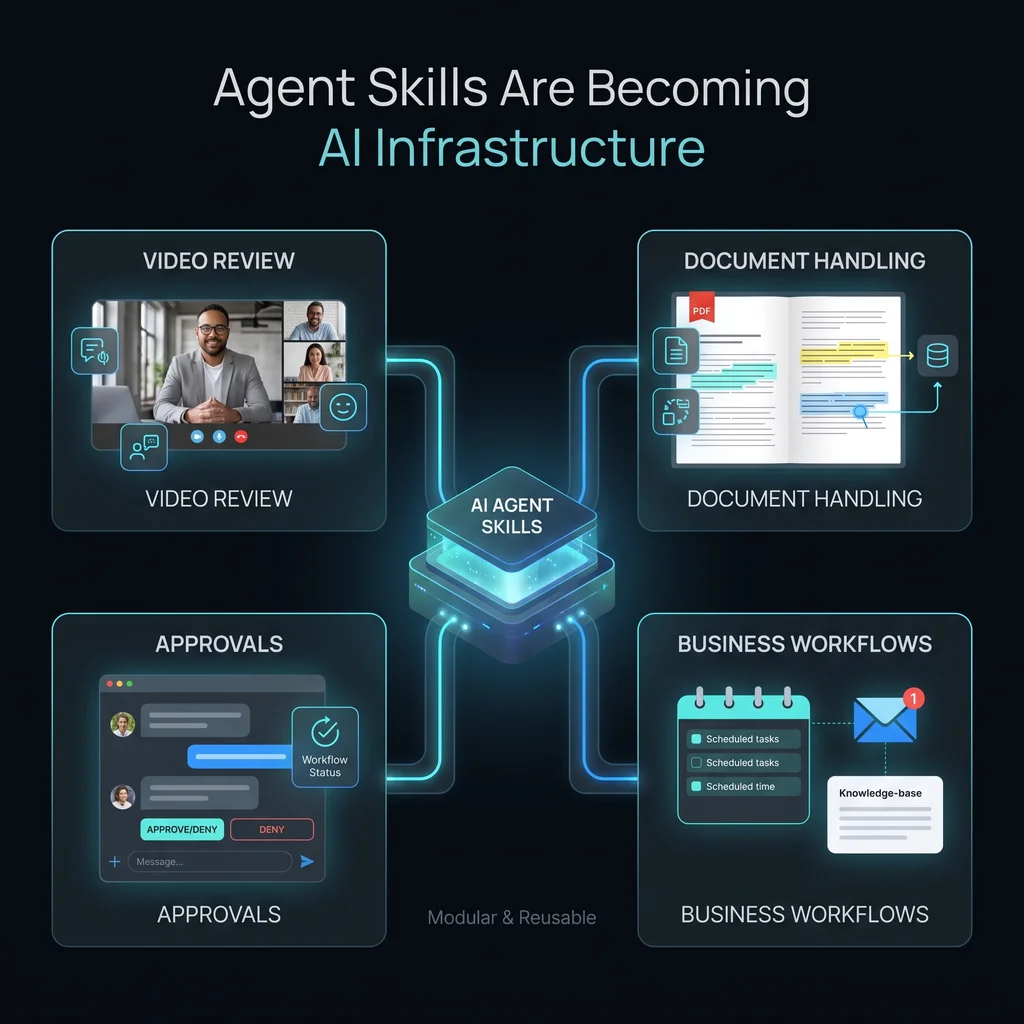
AI agent skills are starting to look less like prompt tricks and more like reusable operating procedures. For Kansas small business owners and operators, that shift matters because the question is no longer only, “Which AI tool should we try?” The better question is, “What can this agent touch, how do we know what happened, and who approves the work before it affects customers?”
Public Claude Skills documentation describes skills as packaged instructions, scripts, and resources that Claude can use for specific tasks. An arXiv agent-skills analysis points in the same direction: skills are becoming modular capabilities that can be shared, reused, and connected to larger agent systems. That makes AI more useful, but it also makes review and permission boundaries more important.
For Expert AI Services, this is a practical operations story. AI should simplify work, not bury owners and staff in another layer of software clutter. When skills are built and governed well, they can help teams repeat good work more consistently. When they are treated like casual prompt snippets, they can create confusion around sources, approvals, and responsibility.
The early phase of AI adoption was full of one-off prompts. A founder, office manager, or coordinator would learn a useful phrase, paste it into a chatbot, and hope the result was close enough. That can help with brainstorming, but it does not create a dependable workflow.
AI agent skills change the shape of the work. A skill can package instructions, examples, supporting files, and task-specific logic so the agent does not start from scratch every time. That means AI agent skills can behave more like reusable AI workflow modules than loose notes in a document.
For a small business, the useful question is not whether a skill sounds advanced. It is whether the skill makes a repeatable job clearer, safer, and easier to review.
This is why the infrastructure language matters. Infrastructure is the stuff a business relies on repeatedly. If a skill helps review documents, prepare customer messages, summarize files, or route approvals, it is no longer just a clever shortcut. It is part of how work moves.
Agent infrastructure does not have to mean a big enterprise system. In a small business, it may mean a controlled set of skills that help with intake, document handling, approval packets, follow-up messages, or internal reporting. The value comes from making the work repeatable and visible.
Claude Skills are one public example of this shift. The documentation shows how a skill can bundle instructions and resources for a task. Public skill projects also show how the idea can move beyond writing help into more specific business workflows, such as reviewing media or handling task-focused inputs.
That does not mean every public skill belongs in a live business process. It means owners should understand what is inside a skill before it is allowed near customer records, financial details, approvals, or external messages. Source trust becomes part of the operating model.
A practical implementation starts with a narrow workflow. Pick one repeated job where the team already knows the desired outcome. Then define what the skill may read, what it may create, and what must stay under human approval. This keeps small business AI operations grounded in real work instead of tool excitement.
For example, a skill that prepares a draft summary from approved source material can be useful with light review. A skill that updates a system, sends a customer message, or triggers an automation needs a stronger permission boundary. The difference is not technical trivia. It is the difference between assistance and action.
Kansas businesses tend to value clear responsibility. That instinct fits this moment well. If AI agent skills are becoming part of daily operations, each skill should have an owner, a purpose, and a review path.
Start with source review. Know whether the skill came from vendor documentation, a public repository, an internal build, or a partner implementation. Skills can include more than plain instructions, so the source and contents matter. If nobody can explain what the skill does, it is not ready for a live workflow.
Next, review permission scope. A read-only skill is different from a state-changing skill. Reading a document, drafting a summary, and organizing notes may be acceptable early use cases. Updating records, sending external messages, changing payment information, or triggering connected automations should require explicit approval.
Then review failure recovery. If an agent uses the wrong source, repeats an action, or misunderstands the workflow, the business needs a simple way to stop the process, inspect the history, and correct the output. This is where audit logs, execution history, and human signoff become practical safeguards, not paperwork for its own sake.
A good first step is a skill inventory. List the skills your team uses or plans to use, the process each one supports, the systems it can access, and the person responsible for final approval. Keep the list plain enough that a nontechnical manager can read it.
Second, separate low-risk assistance from state-changing work. Drafting, summarizing, and sorting can often begin with lighter review. Anything that changes business records, communicates externally, or triggers another system deserves tighter controls.
Third, connect each skill to a business outcome. If a skill helps a manager prepare a cleaner approval packet, helps staff reduce repeated copy-and-paste work, or helps an owner understand incoming requests faster, it is doing useful work. If it only adds another place to check, it may not be worth adopting.
Expert AI Services helps teams think through these choices with custom AI services built around practical workflows. That may include model-agnostic stack planning, AI agents for repeatable tasks, or applied products such as SMSai where automation supports communication without removing human judgment.
The strongest AI systems for small businesses will not be the flashiest. They will be the ones where skills are visible, scoped, reviewed, and connected to real work. If your team is ready to move from scattered prompt experiments to dependable agent infrastructure, talk with an AI integration lead about how to make the workflow useful before making it bigger.
Source
arXiv agent-skills analysis and public Claude Skills documentation
Kansas Impact
Kansas small businesses should treat skills like reusable operating procedures, not casual prompt snippets, before using them on customer or financial workflows.
Key Takeaway
Skills make AI more repeatable, but repeatability creates a new need for review, source trust, and permission boundaries.