
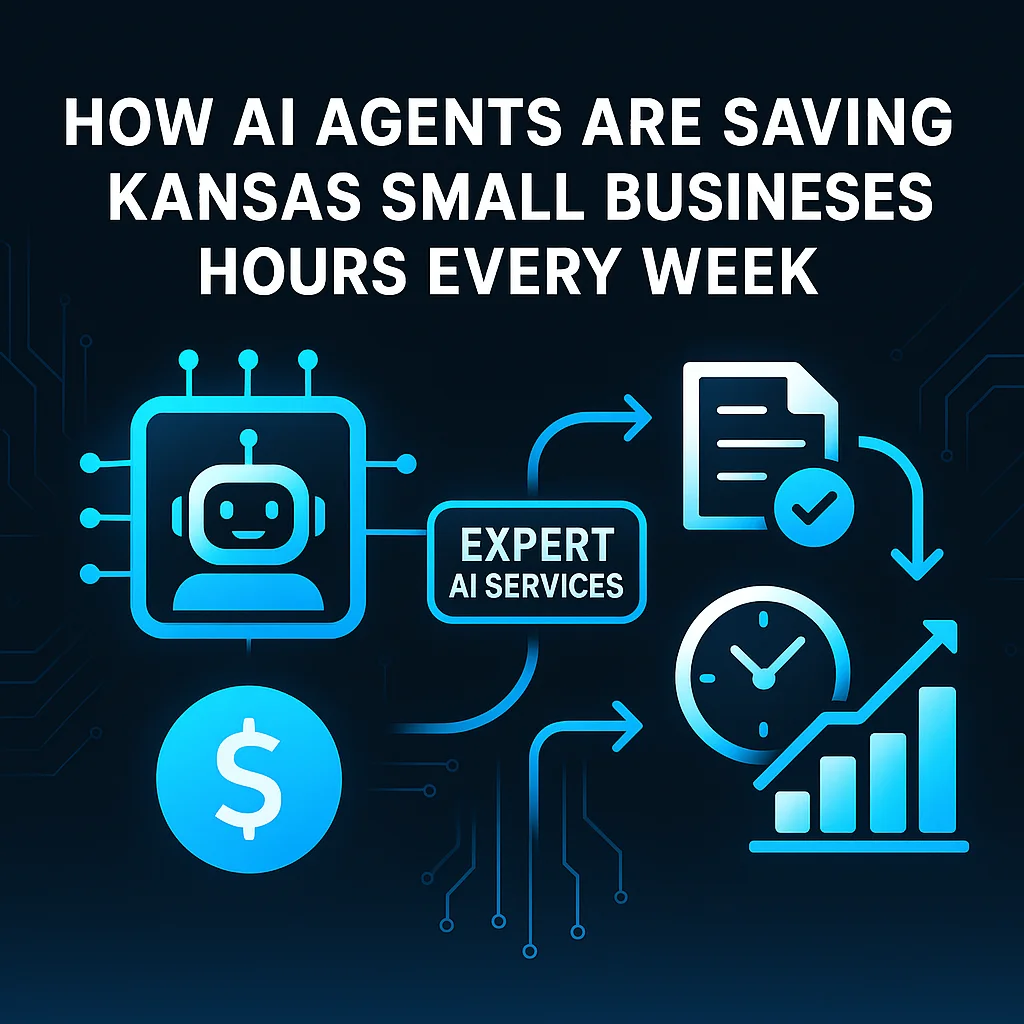
If you run a local business, chances are the phrase "AI agents for small business" feels like a Silicon Valley talking point. But time constraints are very real on Main Street: owners juggle phone calls, spreadsheets, customer follow-ups, invoices, and field schedules. Every extra hour spent sorting emails or tracking paperwork is an hour lost from growing the business.
Many Kansas small businesses, from family-run mechanics to Main Street retailers, struggle to keep up with staffing shortages and rising operational demands. According to practical ChatGPT automation discussions, these challenges often force business owners to wear too many hats—sometimes resulting in burnout or costly errors.
Manual office work like email sorting and schedule coordination quietly robs even the most diligent teams of valuable hours every week.
Most owners know the problem well, but traditional solutions don't always fit the Midwest. Off-the-shelf software may solve one headache but create four more, and hiring just isn’t possible for many at current wage rates.
Historically, small businesses have leaned on paper checklists, overstuffed spreadsheets, and piecemeal apps to bridge the gap. But these solutions often:
The real limitation isn’t technology—it’s time, training, and the reality of Midwest business operations.
Traditional business software was built for big companies with IT departments. Most local Kansas businesses need solutions that work straight out of the box, without expensive consultants or lengthy onboarding.
Owners can’t solve time crunches by working harder. Local operators need ways to simplify repetitive work so that their team, often already stretched thin, can focus on the jobs that require a personal touch.
The latest wave of AI agents for small business is designed for practical, day-to-day tasks. These digital assistants aren’t about replacing people—they augment teams. Think of AI agents as workflow helpers: they read incoming inquiries, file paperwork, schedule appointments, and even draft routine replies, all without fuss.
Accessible tools like ChatGPT Operator, Claude, n8n, and Zapier AI put this power within reach for local businesses—no lengthy contracts or vendors required. Many in the Midwest have already started building their own automations, as highlighted in OpenAI user experiences and case studies and AI agent automation strategies.
AI is here to simplify—not complicate—operations for the working class business owner.
A third-generation auto repair shop in central Kansas faced daily headaches just coordinating service appointments. Between voicemail games and double-booked slots, valuable technician hours were getting lost to logistics. By deploying an AI scheduling agent, the front desk now receives a prioritized list of actual appointment requests with suggested times, automatically resolving conflicts and updating the ledger. Staff review all changes before confirming, but the tedious back-and-forth calls have dropped by 70%.
Empowering employees to focus on customer care rather than busywork can transform workplace morale.
A local boutique on Main Street used to depend on handwritten call-back lists for ‘hot’ customers—until those lists got buried. With a simple workflow using Zapier AI, every time a purchase or lead is logged, an AI agent drafts a personalized follow-up and reminders are queued in the right staff member’s inbox. No more missed opportunities, and the owner estimates staff reclaimed at least two hours a week, now spent on better merchandising and customer service instead.
For one HVAC contractor, field techs snapped photos of receipts and site notes, but back-office data entry kept piling up. A lightweight AI agent OCRs each image, transcribing details into client records before the end of the day. The boss? Now less worried about payroll surprises or lost job details, since everything is searchable and current.
Kansas small businesses adopting AI automation for daily operations are reporting measurable time savings—even when starting small. Tasks that once took several hours a week can often be completed automatically in the background, giving owners and employees back crucial time each day. In some featured success stories above, it’s not uncommon to reclaim 1–3 hours per team member per week.
According to analysis from TechCrunch on OpenAI agent trends, businesses across all sizes are seeing substantial efficiencies—proving this isn’t just an enterprise trend.
The most important outcome: Staff feel less burdened by repetitive work, and customers enjoy quicker, more accurate responses.
Instead of chasing down paperwork or manually sending reminders, Midwest teams can focus on the jobs that truly make a difference for their business.
For local operators, skipping the "one-size-fits-all" tech and instead investing in practical, model-agnostic custom AI services rooted in Kansas expertise can make all the difference. Our experience comes from decades in controls, field service coordination, and translating technology to actual business results—not just startup jargon.
Key Takeaway: AI works best when paired with local understanding and a focus on simplifying—not replacing—your core operations.
For those evaluating where to begin, platforms like SMSai—AI-powered messaging built for field teams and operators—offer a low-risk way to road-test automation in real Kansas business scenarios.
Curious how AI agents could fit your local workflow? Talk with an AI integration lead and explore custom solutions tailored to Kansas small business realities. No pushy sales, just honest conversation—and practical steps you can try today.
Client Type
Kansas small business operators (auto shop, retailer, contractor)
The Problem
Staffing shortages and repetitive paperwork draining time and limiting growth
The Solution
Deployed accessible AI agents for email, scheduling, follow-ups, and data entry
Result
Staff reclaimed 1–3 hours per week for core operations
Result
Reduced manual coordination errors and improved customer service
Result
Increased accuracy of records and faster invoicing, enhancing cash flow
Conclusion
Key Takeaway: AI works best when paired with local understanding and a focus on simplifying—not replacing—your core operations.