
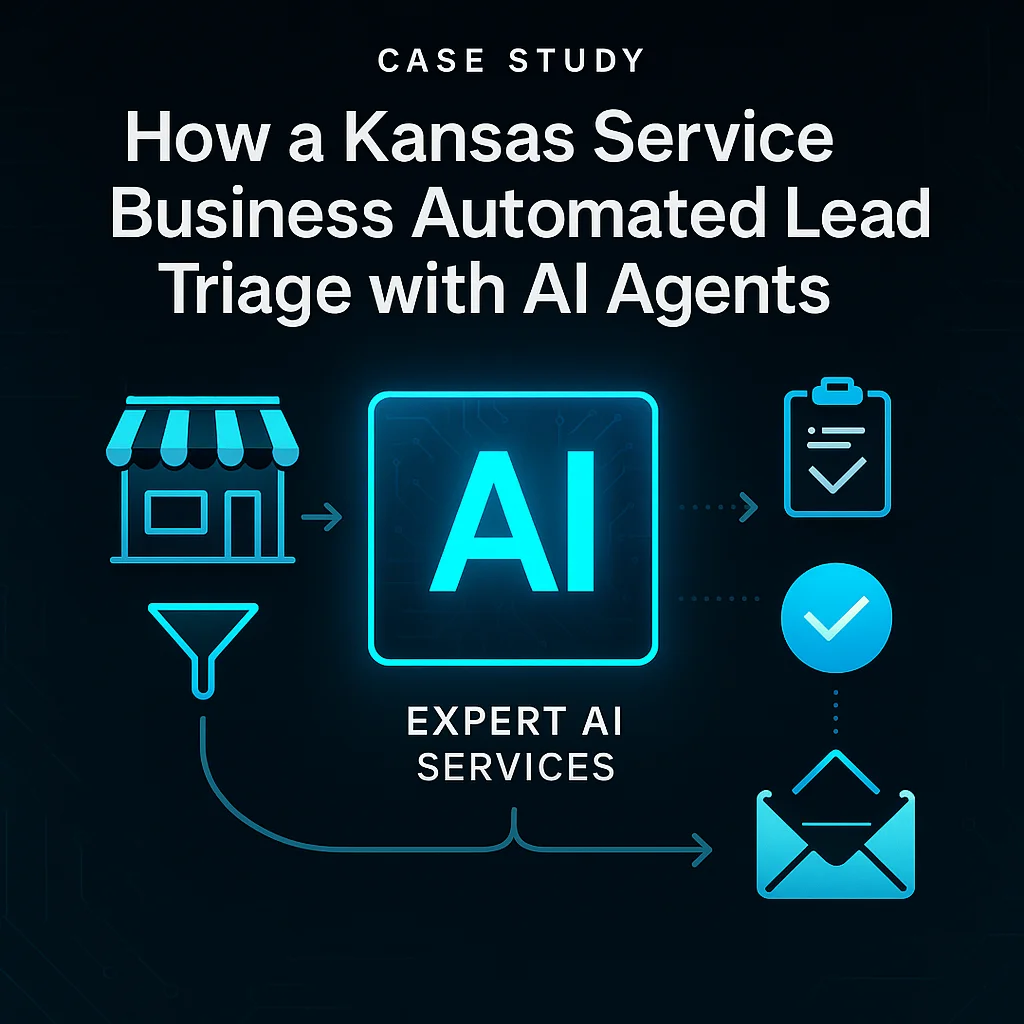
If you're searching for a down-to-earth AI lead triage case study that shows how real Midwest service businesses can benefit from AI agents—without the Silicon Valley hype—you’re in the right place. This is the story of a Kansas service company that tamed lead overwhelm through workflow automation. Backed by regional expertise and a model-agnostic stack, this narrative offers lessons for operators who value reliability and measurable outcomes above buzzwords.
Business was great—maybe too great. A local HVAC and plumbing service, with a small but hardworking team, suddenly found their main web contact form was becoming a bottleneck. Leads flooded the inbox each day. Sorting through genuine requests, tire-kickers, and spam was costing the office manager hours each week.
For small service businesses, every minute spent sorting leads means less time booking jobs and keeping technicians moving.
Worse, valuable opportunities sometimes slipped through the cracks while the team fielded less urgent, lower-priority contacts. Response times varied wildly depending on who saw the email first, and high-value customers could find themselves waiting days for a reply.
Manual lead triage in small businesses is rarely a dedicated role—it's one more task for someone juggling dispatch, inventory, billing, and the phone. Here’s what this Kansas company struggled with:
Repetitive triage not only wastes skilled employees’ time—it nudges top prospects into the arms of faster competitors.
Looking to escape the cycle of manual lead management, the company explored off-the-shelf CRMs, basic form builders, and automation bolt-ons. Yet most tools were:
The right solution needed to:
Ultimately, what caught their interest was the idea of model-agnostic, integration-focused AI agents—built to fit the unique needs of small Kansas businesses.
After a free operations audit with Expert AI Services, the company saw the opportunity to automate their lead triage process without ripping and replacing existing systems. The delivery model was straightforward:
Model-agnostic stacks avoid vendor lock-in—key for local businesses that don’t want to gamble on one tool or provider.
Trigger: New contact form →
AI agent (Claude/ChatGPT) reads details
↓
MCP integration routes data
↓
AI assigns priority & drafts a response
↓
Human review (optional)
↓
CRM/log updated instantly
This modular approach draws from proven r/AI_Agents community discussions—practical setups that genuinely work for operators. By keeping the AI agent focused and the integration stack minimal, the process remains affordable and future-proof.
What happened after deployment? The difference was visible within days:
Reception and sales teams finally had space to focus on serving customers—not sifting through digital clutter.
The company's team found that, rather than replacing staff, AI-powered lead triage allowed them to focus on jobs only people can do: upselling on the phone, dispatching the right technician, coordinating with suppliers and property managers.
Some worry that AI means "massive budgets or risky experiments." In reality, for a small or mid-sized service company, the investment is manageable. Unlike the high-cost, high-complexity enterprise agents described in TechCrunch coverage of OpenAI, practical agent stacks using open models and light integration can stay affordable for local businesses.
This AI lead triage case study offers a few clear lessons for operators considering automation:
Key Takeaway: For Kansas service businesses, AI doesn’t mean replacing what works—just freeing up time, reducing missed leads, and helping real people serve customers faster.
Many of the best ideas come from r/ClaudeCode workflow examples and from local operators sharing what’s worked. For others seeking guidance, consider a straightforward, AI-aware audit—see what’s possible, one workflow at a time. If your team is weighing the leap, know that practical SMS-based AI assistants are already helping local businesses coordinate, triage, and deliver faster every week.
Curious how custom AI lead triage would work for your crew? Expert AI Services combines real Kansas know-how with proven AI delivery—you’ll never get a tech for tech’s sake pitch. Discover how less software and more useful automation can work for you.
Client Type
Kansas HVAC and plumbing service business (anonymized)
The Problem
Manual lead triage led to missed opportunities, slow response times, and overwhelmed staff
The Solution
Deployment of model-agnostic AI agents (Claude/ChatGPT + MCP) to read, classify, and route leads automatically while integrating with CRM and email
Result
High-urgency leads were flagged and responded to in minutes, not hours
Result
Office staff reclaimed hours per week, focusing on customer service instead of triage
Result
Missed leads decreased and customer satisfaction improved with faster replies
Conclusion
Key Takeaway: For Kansas service businesses, AI frees up people to serve customers—not to replace them. Model-agnostic workflows mean operators can start small and see real benefits without big risks.