
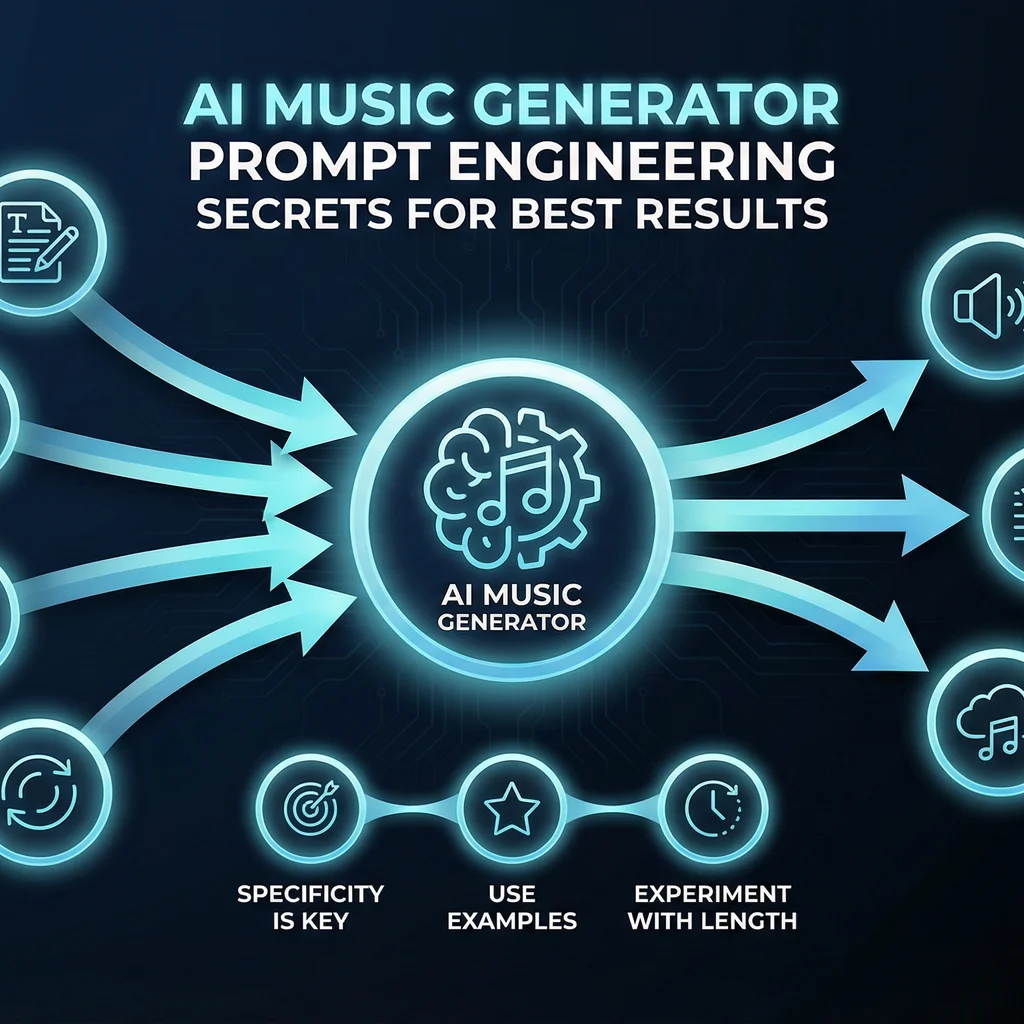
If you've tried an AI music generator and felt something was missing, you're not alone. The difference between a bland loop and a track that fits your project often comes down to prompt engineering. The secret to getting the best AI music generator results is structured, deliberate prompting—not just a few random keywords.
AI music generator prompt engineering gives you creative control by specifying genre, mood, tempo, instruments, and detail. The more intentional you are, the better your outputs.
AI music tools like Google's Gemini, Lyria 3, Suno and others have opened new creative workflows for content creators, marketers, and small business teams. But you only get professional-quality results if you know how to "speak their language" via prompts.
Let's break down what works, what doesn't, and how to refine your AI music prompts for creative and business success.
The foundation of prompt writing for music AI is simple: the more context your prompt provides, the more the AI has to work with. Use the 'Golden Formula' to cover the essentials:
The Golden Formula: [Genre] + [Mood] + [Tempo/BPM] + [Vocals/Instruments] + [Specific Details]
Describing artist style? Direct artist name prompts on Lyria 3 or Gemini will be diluted by their content guardrails (see TechCrunch's coverage of Gemini music generation). Instead of "like The Beatles," describe the sonic characteristics: "British 60s pop, lush vocal harmonies, jangly guitars."
Let's walk through an AI music prompt engineering workflow using the Golden Formula as a template. This method helps generate consistent, high-quality music for business content, videos, ads, or podcasts.
Genre: Uplifting indie rock
Mood: Confident and optimistic
Tempo: 120 BPM
Instruments: Guitar-driven with subtle synth layers
Specifics: Designed as a podcast intro for small business interviews
Starting from this template, adjust one piece at a time (e.g., increase BPM, try a different lead instrument, add a targeted mood word) and rerun until you get the right feel.
Not sure where to start? Here are several proven AI music prompt examples using major generators like Gemini or Lyria 3. Each one intentionally avoids direct artist name and uses descriptive cues instead.
Need consistent brand music? Save and version control your prompts for each campaign or video series. Use themes and keywords ("steady optimism," "authenticity," "Kansas roots") so every audio asset helps build brand identity. AI music can be batch-generated and curated for future use—think campaign libraries, not just one-off tracks.
Noisy results, bland tracks, or outputs that sound off? Most issues can be traced to vague prompts or conflicting cues. Here's a practical guide to troubleshooting:
If you keep getting poor results, save unsuccessful prompts as "anti-examples"—these help you spot what not to do next time.
Ready to level up your AI music generator prompt engineering for business and creative impact? Try these advanced strategies:
To maintain a reliable sonic brand, repeat prompt elements, save settings, and review different platform responses as described in Gemini's music generation overview.
Prompt engineering lets you move from one-off tracks to scalable audio content—essential for consistent brand voice across marketing materials.
AI music is more than a novelty—it’s a practical tool for modern brand campaigns, content marketing, and multi-channel customer experiences. Content creators can quickly produce variety, while marketers can maintain message and emotional tone at scale. When your business wants distinct music for social posts, ad campaigns, or explainer videos, prompt engineering becomes the bridge between "AI-generated" and "actually useful."
Leading-edge teams document their most effective prompts, map outputs to brand style guide criteria, and coordinate review cycles before release. For advanced integration or help establishing your own "AI music playbook," talk with AI integration leads for custom support.
Explore how expert prompt engineering elevates your content, campaign, and creative workflows with business-ready music AI. Talk with an AI integration lead and bring custom audio automation to your brand!
Difficulty Level
Intermediate
Action Item
Apply the Golden Formula to your next AI music prompt and iterate for improved results.
Tools Mentioned
Gemini, Lyria 3, Suno, Deezer, Spotify AI
Time to Implement
30 minutes