
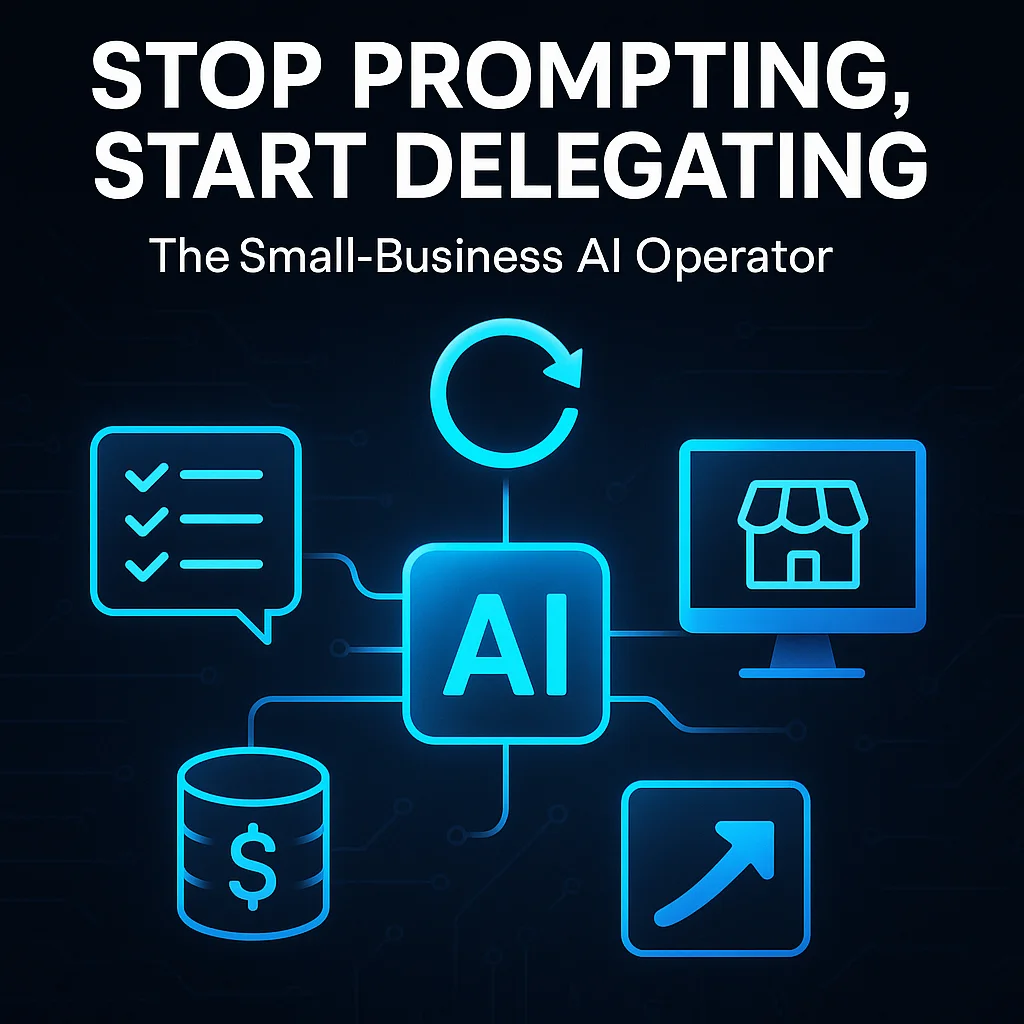
AI delegation for small business is a leap beyond clever prompting—it’s about building repeatable, dependable workflows, not just getting good answers from ChatGPT or Claude. Most small businesses start their AI journey by writing and re-writing prompts, hoping for consistent responses. That approach quickly hits a wall: clever prompting can’t match the reliability or auditability small teams need from true automation.
Most small businesses are stuck at the clever prompt phase—and it’s holding them back from real, time-saving automation.
Just as you wouldn’t hand your accountant a sticky note with half a plan, you shouldn’t expect ad-hoc AI prompts to reliably run operations. The future of small business automation relies on repeatable, tool-connected workflows known as operator loops, blending AI efficiency with practical human oversight.
The AI operator loop is an automation pattern designed for real-world operators, not large enterprise IT teams. At its core, it’s a connected workflow: AI agents hook into your business tools, intake requests, pull live context, draft actions, and pause for a quick approval before executing. This model is spreading fast across small business forums and operator communities like r/ChatGPT community discussions, r/OpenAI operator insights, and r/AI_Agents agent workflow discussions.
Why is this shift so important? The operator loop provides:
The near-term winner is not the flashiest model; it is the team with the cleanest delegation pipeline.
Moving from one-off prompts to repeatable AI tasks means shifting your mindset. Instead of asking, “How do I prompt ChatGPT for a sales summary?” ask, “How can I design a process so the AI drafts all sales summaries, pulls customer context automatically, and lets my team approve before sending?”
# Operator Loop Template
input: new task request
action: pull context from system X
draft: AI writes initial version
approval: human operator reviews
execution: send/update/do X
Instead of copying prompts over and over, you get a standardized workflow—no more missed steps or inconsistent results.
Not every task is ready for full automation. The smartest approach is to begin by delegating work that is well-defined, low-stakes, and repeated often. This gives your team confidence while freeing up valuable time.
Hand off what’s routine; keep control over what’s critical. Approval gates are your safety net on the path to scaling with AI delegation.
For Kansas operators, this balance of automation versus hands-on oversight is what sets trustworthy AI systems for small business apart from risky, hands-off black boxes.
In an operator loop, the human isn’t replaced—they become the expediter, the one who reviews, tweaks, or vetoes AI outputs. This keeps expertise in the loop and ensures your workflows reflect local business logic and relationships.
Every operator loop should have at least one clear approval checkpoint before any action touches a customer, vendor, or public record. This built-in pause is what separates practical deployments from risky, set-it-and-forget-it automations.
Approval checkpoints add both reliability and confidence to small business AI automation. The operator loop doesn’t run away—it waits for your say-so.
For more on how approval checkpoints look in real-world workflow automation, explore our team’s SMSai deployment—built to put people in control of smarter, faster communication.
Consider a Kansas field service company tired of manually confirming every new job appointment. They set up a simple delegation loop: when a request comes in via SMS, an AI agent pulls the contact info, drafts a confirmation message, and pauses—waiting for a dispatcher’s review. With a single click, the message is sent, logs are updated, and the next request begins.
When tracking time saved and error rate over two weeks, the team saw noticeable efficiency gains—without overhauling their tech stack or sacrificing control.
Practical starter loop: pick one repetitive process, connect only required tools through an MCP-style layer, define one human approval gate before external actions, and track cycle time plus error rate for 14 days.
If you're curious about what goes into scoping, configuring, and evaluating an operator loop, our company profile describes the hands-on approach rooted in building automation and field coordination.
While an operator loop brings new power to your small business AI automation, there are traps to avoid:
Industry conversations—from r/ClaudeAI workflow automation threads to r/mcp model-agnostic integration posts—agree: tight operator loops beat one-off clever prompting for small teams. For a deep, hands-on walkthrough of MCCP-style architecture in production, see Simon Willison’s Software Factory explainer.
The future isn’t endless tweaking of prompts; it’s building clean operator loops where AI truly works for you.
If you want to see how AI delegation looks in the field—paired with your real-world process, tools, and team priorities—let’s explore it together.
Difficulty Level
Intermediate
Action Item
Start building your first operator loop with a single approval checkpoint.
Tools Mentioned
ChatGPT, Claude, SMSai
Time to Implement
Under 1 hour for a basic loop