
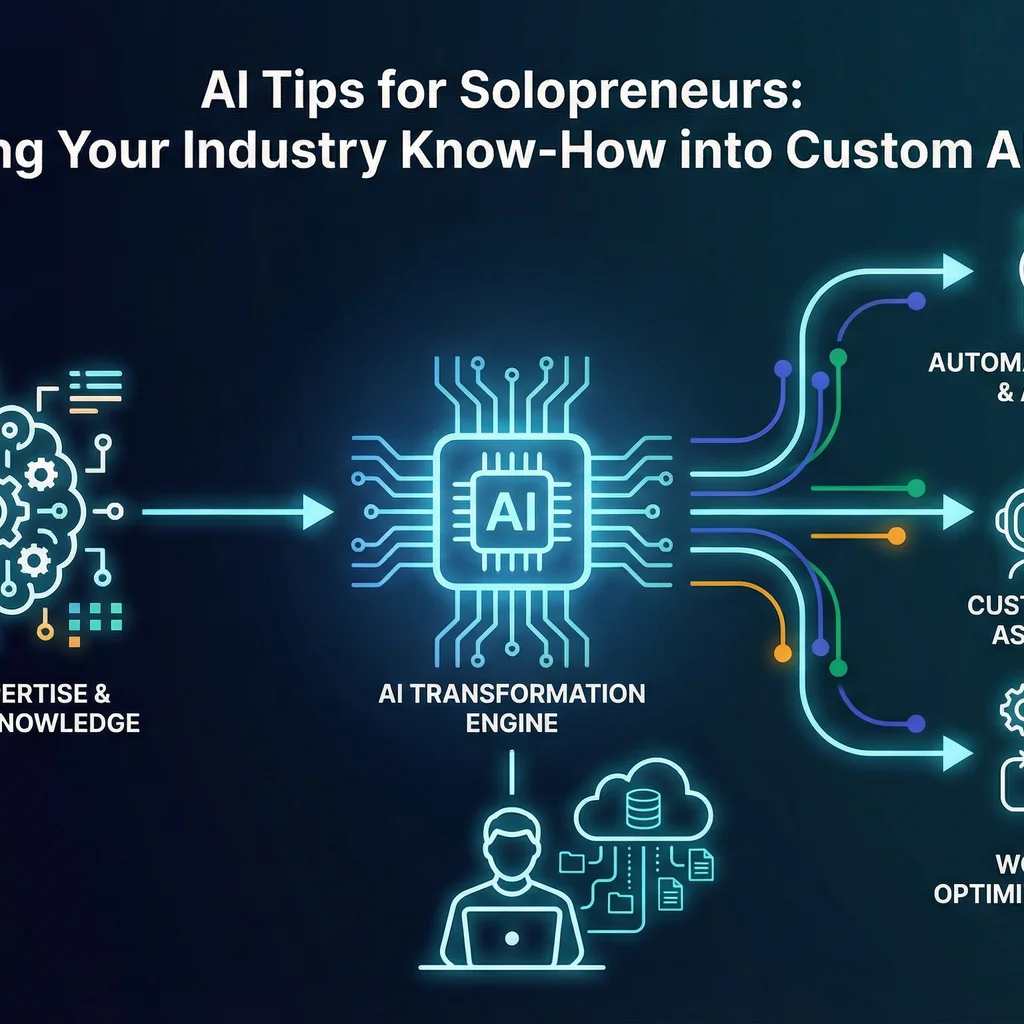
If you’re a solopreneur, consultant, or small business owner, you already possess the most valuable ingredient for building custom AI tools for solopreneurs: your deep, hard-won industry know-how. The revolution in AI isn’t just for tech giants—it’s rewriting what individuals with niche expertise can create. With today’s AI services, your operational playbooks and intuition for what works are now buildable into responsive, intelligent solutions that work for you.
Your 20 years of knowing which parts fail in which seasons... that knowledge is now directly buildable into AI tools.
This shift means that non-developers with domain expertise and just enough AI fluency are emerging as central builders in their fields. No need for a massive team—solopreneurs can now productize what makes them unique, serving niche markets that big software vendors overlook.
There are two main approaches for custom AI tools for solopreneurs—no-code builder platforms and working with technical partners to design more advanced automation. The decision depends on your needs, time, and the value of your unique expertise.
The people who succeed won't be the ones who learn to code. They'll be the ones who already know their industry cold and learn enough AI fluency to describe what they want built.
Whichever path you choose, the most important skill is the ability to describe your process clearly—what’s done, when, and why.
The path from expertise to automation can happen surprisingly fast, often in a matter of hours or days. Let’s break it down with a hands-on approach:
You are an assistant for a small insurance consultancy. Use only the client’s onboarding forms and previous communications to answer compliance questions. If unsure, escalate to the owner.Pro tip: Your AI tool is only as good as the instructions and sample data you give it. Start simple, then layer in complexity as you learn.
You don’t need to become a programmer to productize your expertise. Entrepreneur.com highlights a new tech stack: solopreneurs leverage no-code AI tools to hit impressive revenue marks (PrometAI calls this the rise of the solopreneur tech stack).
Some businesses choose a hybrid route—starting with no-code, then hiring a developer to take the proof-of-concept to the next level.
Custom AI tools for solopreneurs are already powering niche market wins. Here’s how industry knowledge translates to automation:
Even local consultants and service providers are building tailored workflows and customer engagement bots. A recent TechBuzz and CNBC report showed that building clone versions of popular SaaS tools is possible in under an hour—at accessible costs. (Monday.com’s response underscores how quickly solopreneurs can compete with niche offerings.)
The minimum viable team for software is approaching one... The real implication is that going independent is less and less of a lifestyle trade-off and increasingly a rational economic choice.
For inspiration, see omnichannel AI communication automation for field service or document intelligence for construction teams in action—each started as a solopreneur-scale idea.
Launching your first custom AI tool is only the beginning. To see real ROI, design a clear feedback loop:
Key takeaway: Successful automation starts simple, measures real results, and adjusts as needed. Iteration beats perfection on day one.
Avoid common pitfalls by setting realistic expectations for what AI can (and can’t) do. Some tasks benefit from hybrid approaches, especially when compliance and trust are involved.
Explore more about responsible, model-agnostic deployment on our company ethos page.
The AI landscape evolves quickly, but solopreneurs can outmaneuver larger teams by staying nimble and model-agnostic. Designing your workflows so you can switch between AI providers easily, route most tasks to cost-effective models, and only pull in high-power AI when needed can save on costs and protect against vendor changes. (Explore the economics of specialized AI agents.)
Future-ready solopreneurs win by focusing on their industry value add, adapting to new AI capabilities, and owning the customer relationship.
If you want a structured path to evaluate your AI readiness, our AI project setup guide is designed for small teams and solopreneurs considering their first automation initiative.
Ready to transform your expertise into a custom AI tool? As AI becomes the new toolbelt for solopreneurs, the path from knowledge to product has never been more achievable—or more rewarding. Let’s talk about building the solution that fits you best.
Difficulty Level
Intermediate
Action Item
Map your core workflow and prototype an AI-powered automation for one repetitive task this week.
Tools Mentioned
Zapier, Chatbot builders, SMSai, DWG Extract
Time to Implement
1-2 hours