
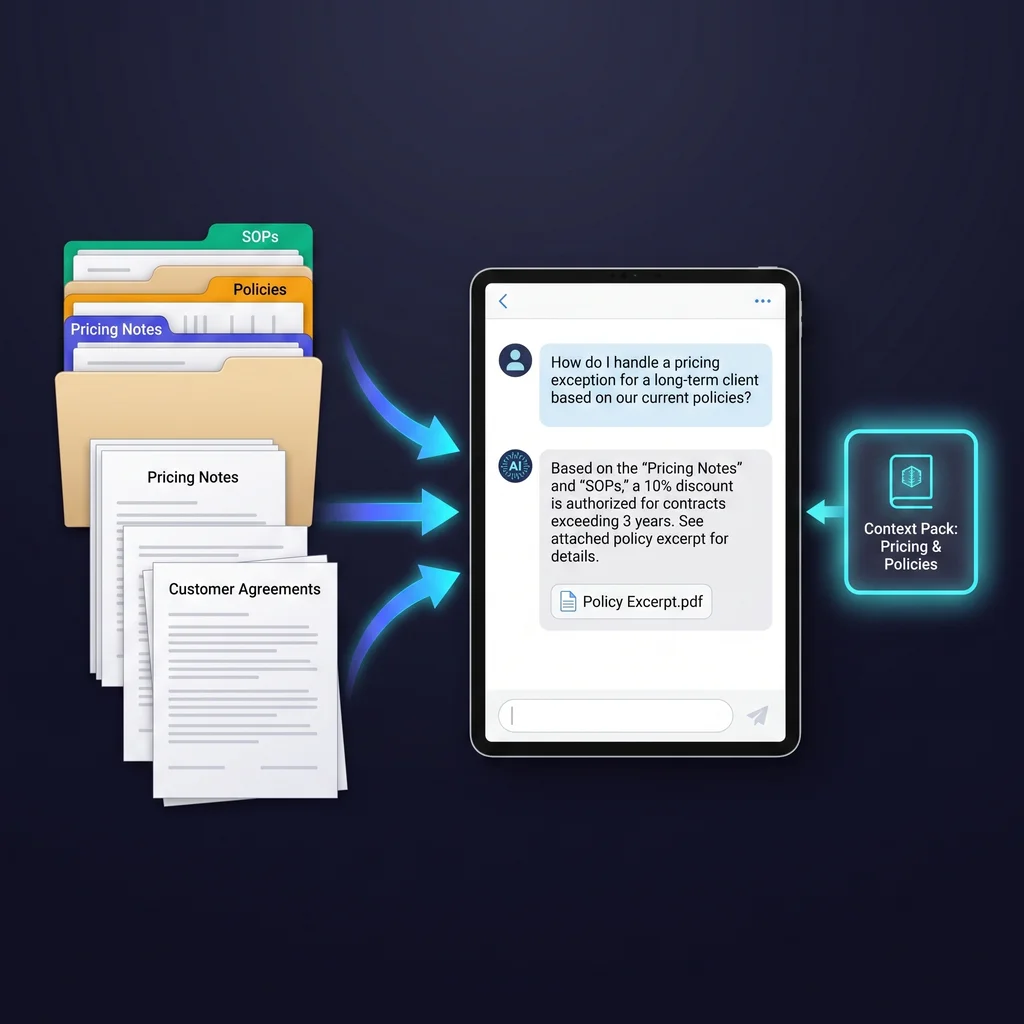
Most business AI problems do not start with a weak model. They start with missing context. A Kansas owner asks ChatGPT or Claude to draft a customer reply, summarize notes, or organize next steps. The first answer looks useful. The third answer drifts. By Friday, every employee is pasting a different version of the same giant prompt into a different chat.
That is why context packs matter. They move the work from one oversized prompt into reusable business instructions. For small teams, this is the practical side of AI context engineering: deciding what the AI needs to know, where that knowledge should live, and how it should be reused across repeated work.
A context pack is a small operating folder for AI work. It can include an SOP, pricing notes, policy rules, examples of good output, examples of bad output, brand guidance, escalation steps, and source documents. Instead of asking one chat to remember everything, the team gives the AI the right packet of instructions for the job.
Anthropic's article on Agent Skills describes a related pattern for agents: organized folders of instructions, scripts, and resources that can be discovered and loaded for a specific task. The open Agent Skills overview also frames skills as portable folders that package specialized knowledge and workflows. A small business does not need to copy that format perfectly to learn from it. The useful idea is that repeated work deserves reusable context.
Giant prompts ask one chat to remember everything. Context packs give repeated work the right operating manual before the work starts.
Long prompts feel productive because they put every instruction in one place. The trouble starts when real operations change. A manager updates one section. Someone else copies an older version. A new employee adds extra wording that sounds right but conflicts with policy. The AI may still answer confidently, but it is no longer working from one shared truth.
That drift is expensive in quiet ways. Customer replies need more edits. Internal summaries miss the same details. Managers spend time restating basic rules. The team starts blaming AI when the real issue is that the business context is scattered.
There is nothing wrong with improving AI prompts for business. Clear instructions matter. But prompt wording is only one layer. If the source rules are unclear, outdated, or hidden in one employee's head, a better prompt will not fix the workflow. Context packs make the source material visible before the prompt is written.
Start with one repeated workflow, not the whole company. Good starter workflows include customer follow-ups, meeting summaries, intake notes, estimate language, service explanations, invoice questions, or weekly task lists. The first pack should answer a few plain questions: What is the goal? What inputs does the AI receive? What rules cannot be missed? What should be reviewed by a person before anything is sent?
A simple pack can include the workflow name, when to use it, the preferred tone, required facts, things to avoid, approval rules, and two or three examples. If pricing, deadlines, legal wording, or customer commitments are involved, mark those as review-required. This keeps AI useful without pretending it owns judgment.
For the first version, create four files or sections: workflow overview, business rules, examples, and review checklist. Put them in a shared SOP document, a folder, or an internal knowledge base. Then test the pack in Claude or ChatGPT with real but safe sample work. The goal is not a perfect first run. The goal is to find which instructions remove repeat explanation.
Pick three repeated workflows that create rework, delay, or too many follow-up questions. Choose the easiest one first. A Wichita office team, a Salina distributor, or an Overland Park professional service firm may all start in different places, but the pattern is the same: capture the rules, test the output, and tighten the handoff.
Plan on 2-4 hours for a first workflow. Spend the first hour gathering existing notes and examples. Spend the second hour turning them into reusable AI instructions. Use the remaining time to test the pack, compare the output against how your team actually works, and mark anything that needs human approval.
Context packs should not live only in one person's chat history. Give each pack an owner, a last-updated date, and a short change log. When the AI misses something, do not just patch the prompt for one chat. Decide whether the reusable pack needs a clearer rule, a better example, or a tighter review step.
This is where reusable AI instructions become a real operating asset. They help teams reduce repeated explanation, keep customer language consistent, and make small business AI workflows easier to train across employees. AI still needs people who know the business. The context pack simply gives those people a steadier way to share what they know.
Expert AI Services helps Kansas businesses turn scattered operating knowledge into practical custom AI services. That may mean building a context pack system, connecting it to shared documents, or shaping an AI agent workflow that fits how the team already works. You can learn more about the local team on the Expert AI Services about page.
For teams that want proof through real products, SMSai shows the same practical mindset: useful automation, clear handoffs, and less software clutter. If your team is ready to stop rebuilding the same prompt every week, start by identifying three repeated workflows and turning the first one into a context pack.
Difficulty Level
Beginner
Action Item
Identify three repeated workflows and turn their rules into a reusable context pack.
Tools Mentioned
Claude, ChatGPT, Agent Skills, shared SOP documents
Time to Implement
2-4 hours for a first workflow