
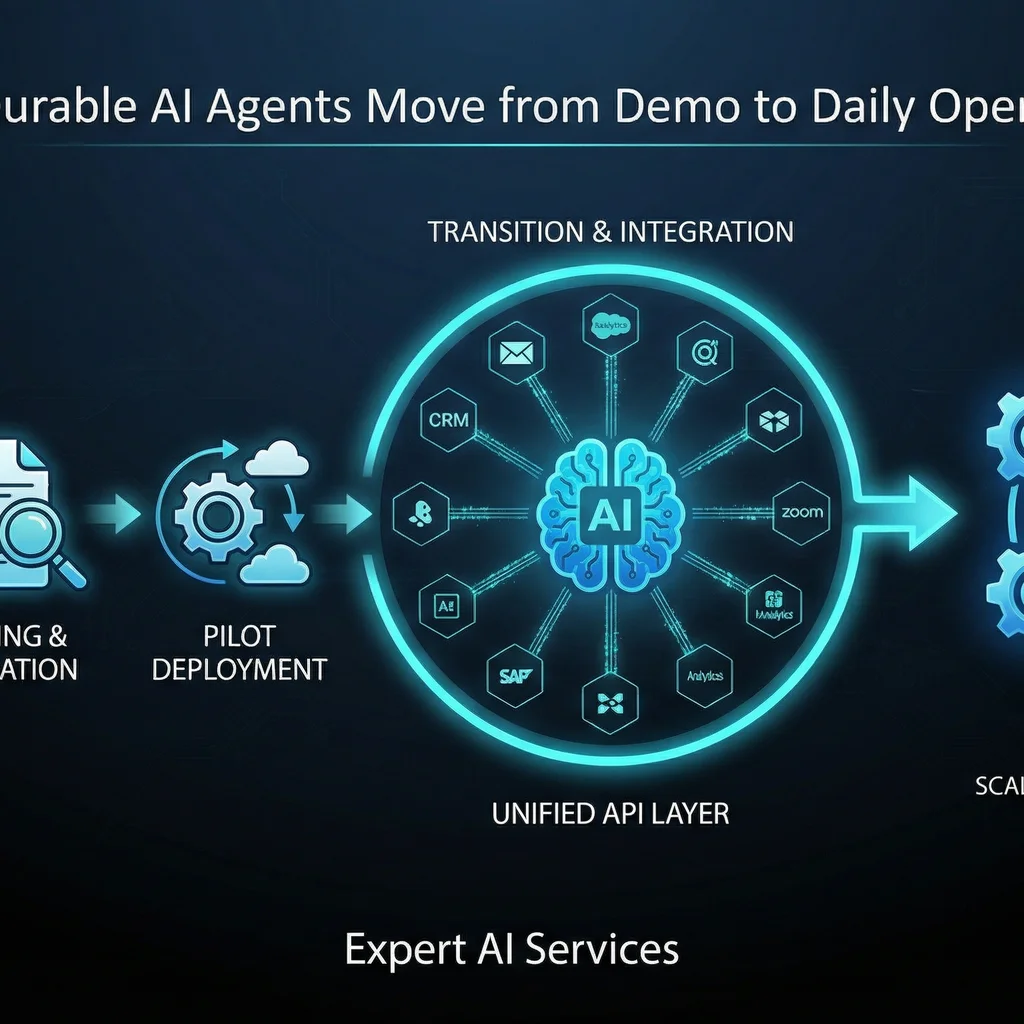
AI agent implementation case study is more than a buzzword—it’s a reality for many small and midsize businesses across the Midwest seeking to remove unnecessary manual burdens and unlock resilient automation. As organizations move beyond the initial hype, the focus has shifted from flashy demos to durable AI agents that keep working, even when the unexpected happens. At the core, these agents simplify, not replace: they take on repetitive coordination, logging, and decision tasks so teams—from technicians to coordinators—can do higher-value work.
Durability is what turns fragile agent demos into production-grade systems you can truly depend on every day.
But the path from a promising demo to a reliable, embedded part of daily operations is rarely smooth. Many business leaders have felt the pain of tools that work on the sales floor but collapse when pressure mounts in real-world use. The goal for small business operations isn’t just AI adoption—it's achieving trustworthy automation that saves time and headaches, without adding software clutter or new risks.
Despite all the recent excitement about generative AI, early experiments with "AI-powered" tools often stall during the leap from pilot to production. Why? A typical demo showcases slick automation—scheduling jobs, parsing emails, or fetching customer details. But under the surface, most basic AI agents lack durable execution and context management. When processes get interrupted—by a network blip, server restart, or human error—these agents forget what they were doing and force staff to pick up the pieces.
"Workflows survive crashes, restarts, and network failures." — Temporal
Industry leaders like OpenAI, Replit, and others now rely on Temporal's workflow orchestration platform for exactly this reason. Small businesses can borrow the same architectural insights—without the hype or sky-high budgets. For Midwest operations, reliability, not just flash, is what wins out over the long term.
Even with buy-in from owners and frontline staff, integrating AI agents into daily work faces practical hurdles. Many proof-of-concept projects fail to become true business process automation because they miss these barriers:
Key takeaway: "AI adoption only works when the solution survives the messy reality of daily business, not just the test environment."
This is where the difference between a demo AI agent and a production-ready, durable agent matters most—especially in the Midwest, where businesses run lean and downtime isn’t an option.
What moves an SMB from a fragile demo to production-grade AI automation? It’s not about chasing the newest algorithm; it's about picking tools and partners built for reliability, context persistence, and team alignment. In one case, a regional field service business started with an off-the-shelf agent to route service requests. It appeared efficient during a controlled pilot but collapsed each time the network stuttered or a process needed to restart. Manual tracking crept back in and frustrations rose.
Getting it right demanded not just technical tweaks, but also a partner who understood construction timelines, dispatch urgency, and Midwest working rhythms. AI agents had to fit the business—not the other way around. That’s the backbone of our approach at Expert AI Services: industry knowledge, local-first consulting, and pragmatic adoption plans.
After deploying durable AI agents built for real-world operations—not just demo floors—the difference was clear and measurable in the business’s everyday life:
Key takeaway: "Durable execution makes AI a quietly dependable helper—one that fades into the background, so the team can focus on what matters most."
The shift wasn’t just technical: it changed how teams trusted and relied on digital helpers. By partnering with firms experienced in AI agent orchestration, many businesses moved from firefighting IT issues to proactive, production-grade automation.
If you want a glimpse into automated communication in action, see our SMSai project for examples of per-contact AI experts handling omnichannel messaging reliably.
Smaller operations can harness the same durable automation technology trusted by industry leaders—if they approach it realistically. Here’s what stands out from the real-world AI case study experience:
Midwest businesses succeed with AI when they ask how it can remove burdens and unlock more useful days, not just add another shiny tool.
For operations managers and owners, the path to AI workflow reliability isn’t about revolution—it’s steady, pragmatic refinement. The Midwest way.
Picture a Kansas field service firm. Before, dispatch coordination meant spreadsheets, manual texts, and chasing down status updates. After integrating a durable AI agent using the approach above, urgent assignments instantly routed to available techs—no matter if WiFi dropped or devices rebooted. Staff started seeing fewer dropped balls and less time reconciling conflicting logs at the end of the day.
Key takeaway: "AI simplified operations, freed up daily work, and quietly boosted confidence for staff who’d seen too many platforms fail in the past."
Ready to explore how expert AI services can help your Midwest business move from demo to dependable business automation? The right partner, process, and architecture make all the difference.
If you’re interested in turning fragile demo projects into reliable, durable automation—let’s have a conversation. Talk directly with an AI integration lead who understands the unique challenges and opportunities of Midwest businesses. No hype, just pragmatic answers and proof from local success stories.
Client Type
Kansas field service business
The Problem
Fragile AI agent demos couldn't survive real-world crashes or daily interruptions, forcing manual recovery and frustrating staff.
The Solution
Deployed durable AI agents using workflow orchestration (like Temporal) for reliable automation, statefully integrated with legacy job-tracking tools.
Result
Reliable automated routing—jobs no longer dropped during outages.
Result
Fewer manual errors, smoother hand-offs between teams, less wasted time.
Result
Staff trust and efficiency improved as AI fit the business work rhythm.
Conclusion
Key Takeaway: Durable AI agents free up daily work, don’t add risk, and make automation useful—not just impressive—on the ground.