
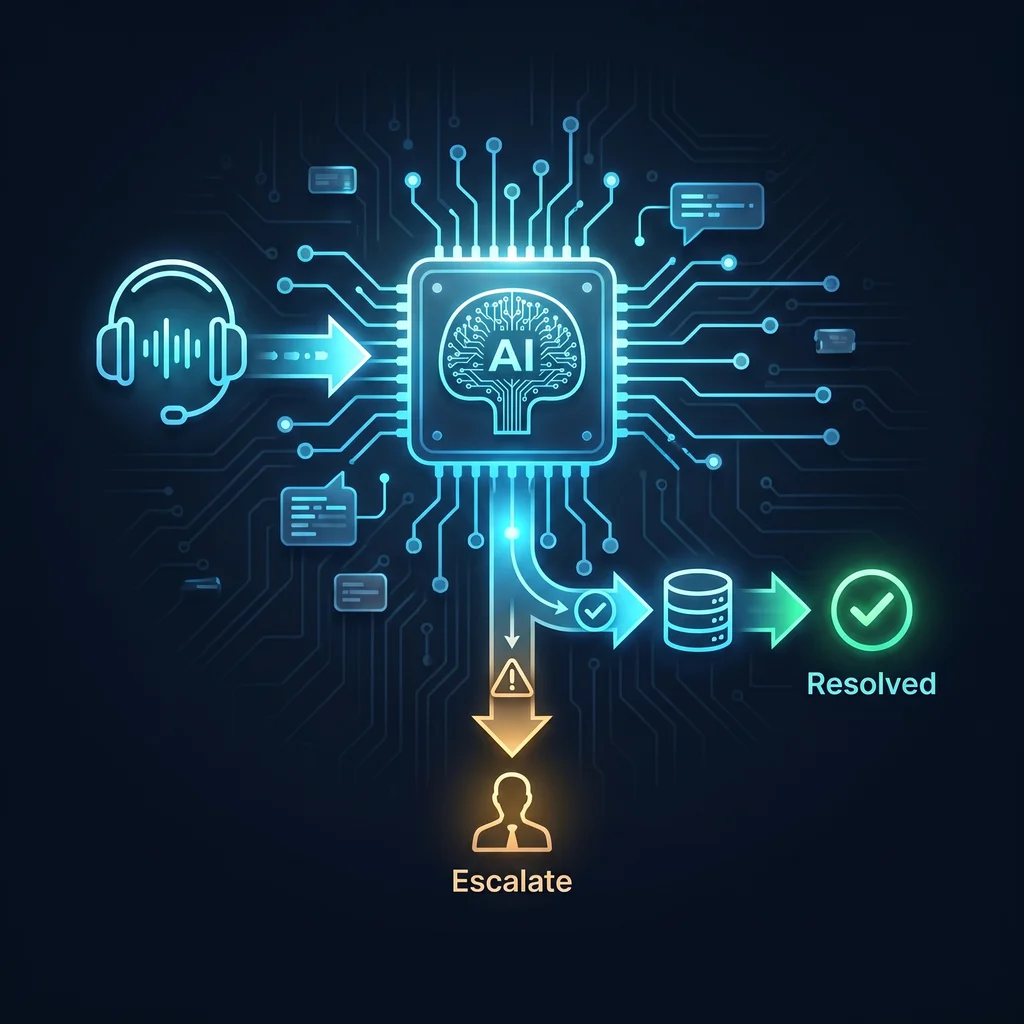
For many ecommerce teams, the real support problem is not that every customer question needs artificial intelligence. It is that the same small group of inbound questions keeps interrupting the people who already have a full day of order review, returns, vendor follow-up, shipping checks, and customer callbacks.
That is where ecommerce support voice agents can be useful. The strongest starting point is a narrow workflow: answer common inbound questions, check order status through approved systems, route return-policy questions, and escalate anything uncertain to a person. The voice agent should not become a free-roaming replacement for the support desk. It should be a controlled front door that gathers context, handles simple requests, and keeps the team from retyping the same answers all day.
A small ecommerce operation does not need a voice agent that pretends to run the whole company. It needs a reliable support lane. That lane might include order-status calls, return-start questions, basic shipping updates, store-policy routing, and clean escalation to a coordinator when the customer needs judgment.
This narrow approach matters because customer-facing automation carries more risk than back-office automation. A mistaken invoice note can be corrected internally. A mistaken customer answer can create frustration, refunds, rework, or a trust problem. The practical goal is not to make AI sound clever. The goal is to make common support steps easier to handle without losing control of the customer experience.
For ecommerce support, the first useful voice agent is not the broadest one. It is the one with the clearest boundaries.
In this case-study pattern, the ecommerce operator starts by mapping calls that already repeat. Customers ask whether an order shipped. They ask when tracking will update. They ask how to start a return. They ask whether an item can be exchanged. They ask to speak to someone when the answer depends on order history, a damaged shipment, a payment issue, or a policy exception.
The voice agent can follow a bounded path. It identifies the request, asks for the minimum information needed, checks approved workflow outputs, and either provides a plain answer or creates an escalation record. If the customer asks about a return, the agent should route through the published policy. If the customer asks about order status, the agent should rely on the order system or a workflow output, not guess from memory.
Common inbound questions are often the best place to begin because they have a known pattern. The customer wants a direct answer. The business wants the call handled consistently. The support team wants the details captured without copying notes between tools. A voice agent can classify the request, collect the order number or customer identifier, and move the call into the right workflow.
Order status and returns should stay tied to deterministic systems. The agent can speak with the customer, but the rules should come from the business. If a return window has closed, the agent should not improvise a new promise. If a shipment looks delayed, the agent should gather the facts and escalate. This is where AI agents and workflow automation work best together: the workflow handles the rule, and the agent handles the conversation around the rule.
A practical support voice agent should not make policy up as it goes. Predictable work belongs in deterministic workflows: order lookup, return eligibility rules, escalation thresholds, support ticket creation, and notification steps. The AI agent belongs around the uncertain parts, such as understanding what the customer is asking, summarizing the call, choosing the right workflow path, and flagging when the situation is outside the script.
This is also why the current operator signal is shifting away from “use a smarter chatbot” and toward “connect AI to the systems where work already happens.” Agent tooling is increasingly built around triggering, inspecting, and auditing workflows instead of replacing the automation layer. That direction is useful for small businesses because it keeps the work testable.
For Kansas business owners and operators, reliability usually beats novelty. A store does not need a voice agent that sounds impressive during a demo but creates cleanup work on Monday morning. It needs a workflow that the team can inspect, limit, test, and improve. That is the same practical mindset behind SMSai: applied AI is useful when it fits a real communication workflow.
The best support automation includes stop conditions. If the order cannot be found, if the customer disputes the policy, if the shipment appears delayed, if payment details are involved, or if the customer is upset, the agent should stop trying to solve everything. It should gather the relevant details, summarize the issue, and hand it to a person with enough context to act.
That worker-first design is important. AI simplifies; it does not replace the people who understand customers, exceptions, and local expectations. For a Kansas ecommerce operator, the practical win is not removing judgment from the business. The win is reducing manual logging, missed details, duplicate calls, and tool overload so the team can spend more time on the exceptions that actually need them.
Before building an ecommerce support voice agent, operators should check whether the support lane is narrow enough to control. The best first version has a small set of approved intents, clear policy sources, known escalation rules, and a way to audit what happened. If the business cannot explain the workflow without AI, adding a voice agent will usually make the mess faster.
The review should include permissions, recovery paths, call summaries, human handoff, and what the agent is not allowed to do. Longer tool-using tasks need extra care because every added step creates another place for the system to stall, misread context, or require human review. More verification can improve safety, but the business still needs a practical path for completion when the agent cannot proceed.
Expert AI Services approaches these projects from building-systems, controls, BAS, low-voltage, and field coordination experience: define the workflow, wire the right systems together, test the failure paths, and keep a person in control where judgment matters. Learn more about the local team at Expert AI Services, then talk with an AI integration lead when you are ready to map one support workflow before automating the whole desk.
Client Type
The Problem
The Solution
Result
Result
Result
Conclusion