
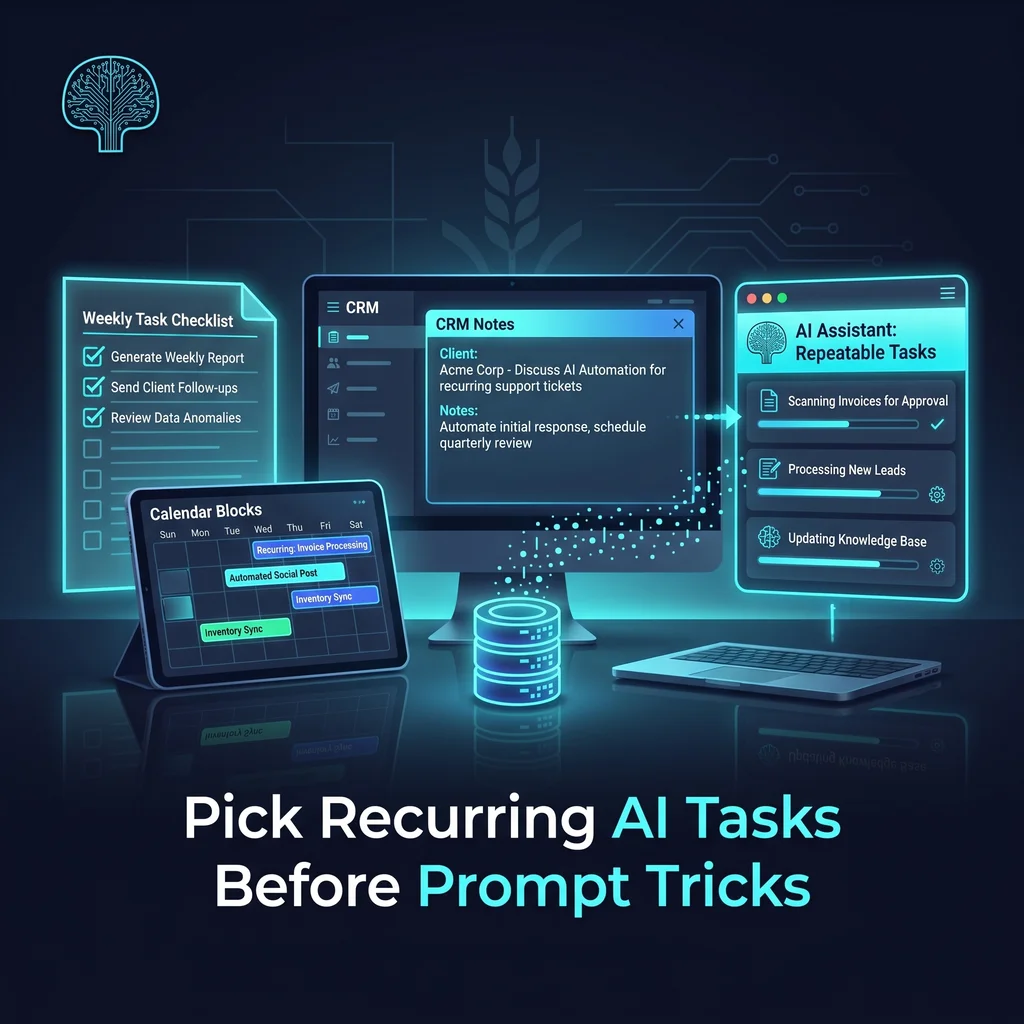
Most Kansas business owners do not need a better prompt library first. They need a calmer way to choose which work deserves AI help at all. If the task happens once, a clever prompt may save a few minutes. If the task repeats every week, the right workflow can save attention again and again.
That is the real starting point for AI tasks for small business: find repeatable work, define the handoff, and keep a person in charge of the final call. Anthropic's Claude for Small Business announcement points the same direction. The product focus is not just chat. It centers on connectors, ready-to-run workflows, and small business jobs such as payroll planning, invoice follow-up, campaign preparation, lead triage, and business summaries.
Pick the recurring job before you polish the prompt.
That rule keeps AI practical. It also keeps owners from chasing every new model demo while the same inbox cleanup, CRM note review, and weekly planning work pile up after hours.
Prompt tricks are tempting because they feel quick. You paste a request, get a polished answer, and feel like the tool is working. The problem is that one-off wins rarely become a business system. A better first pass is to list recurring AI tasks that already have a known input, a known output, and a person who can approve the result.
Take 30 minutes and write down five tasks that happen every week or every month. Good candidates might include summarizing email threads before Monday planning, turning CRM notes into follow-up drafts, preparing a customer check-in agenda, comparing calendar blocks against open commitments, or drafting a short internal update from Google Workspace documents.
Then score each task on three simple questions. How often does it happen? How risky is a wrong answer? How clear is the handoff from AI output to human approval? The best first project is usually frequent, low to moderate risk, and easy for a manager, founder, or coordinator to review.
AI agents are strongest when the source material is already nearby. If the work requires hunting through memory, hallway conversations, and half-finished spreadsheets, fix the input before adding automation. If the work starts from a consistent place, such as a CRM record, shared folder, invoice list, meeting transcript, or email thread, it is much easier to turn into workflow automation.
This is where small business AI tips should stay plain. Do not begin with a giant prompt asking the model to understand your whole company. Begin with one clear packet: the customer notes, the last proposal, the open tasks, and the desired output. That structure is easier to review and easier to improve.
The Anthropic source describes small business workflows where the owner connects familiar tools and approves before anything sends, posts, or pays. That approval habit matters. For Kansas operators, the point is not to make software more mysterious. It is to remove manual clutter while keeping judgment where it belongs.
A useful AI workflow should show its work well enough for a busy owner to make a call. If ChatGPT drafts a customer email, the person approving it should see the source notes. If Claude summarizes overdue invoice context, the owner should know which records were used. If an internal assistant prepares a weekly plan, the team should know what it left out.
The handoff is where many AI workflow ideas become real or fall apart. A demo can look impressive while still leaving the team with copy-and-paste chores, unclear ownership, and no repeatable next step. Before you automate, name the person who starts the task, the system that provides the input, the format of the AI output, and the person who approves or edits it.
For example, a weekly sales follow-up flow might begin with CRM notes and recent email summaries. The AI assistant drafts three follow-up messages and a short call list. A manager reviews the drafts on Friday morning, edits anything sensitive, and assigns the work. That is more useful than a clever prompt saved in someone's notes because it fits the week.
Expert AI Services builds custom AI services with this kind of operator path in mind. The goal is less software, more useful workflows. A model-agnostic stack can use Claude, ChatGPT, or another model where it fits, but the business process should not depend on one novelty feature.
For a first pass, choose one task that takes about 30 minutes and repeats often enough to matter. Do not start with payroll, legal decisions, hiring choices, or anything where a mistake could create a serious problem. Start with preparation work: summaries, drafts, checklists, agenda building, or customer context review.
A Kansas owner might start with Monday planning. Gather the last week's customer emails, open CRM notes, and calendar commitments. Ask the AI assistant to produce a short priority list, unanswered customer questions, and suggested follow-ups. Then review it before the team meeting. The output does not need to be perfect. It needs to reduce the blank-page work and make the human review faster.
Another practical starting point is SMS follow-up. Expert AI Services' SMSai shows how applied AI can support communication workflows without asking a business to rebuild everything around a new platform. The same principle applies here: put AI where repeated coordination already happens.
If your five-task list turns into a bigger map of tools, approvals, and customer touchpoints, that is a sign the work may be ready for AI automation planning. A partner can help separate simple prompt use from a durable workflow, especially when Google Workspace, CRM notes, email summaries, and customer communication all need to work together.
For awareness-stage planning, the local team at Expert AI Services can help owners think through practical fit without forcing a heavy software rollout. The right first project should be understandable, reviewable, and tied to work your team already recognizes.
Before writing another prompt, ask one question: will this task come back next week? If the answer is no, use the tool casually and move on. If the answer is yes, slow down long enough to define the repeatable workflow.
List five recurring 30-minute tasks. Rank them by frequency, risk, and handoff clarity. Pick the one with the best mix of repeat value and easy review. Then write the prompt, connect the source material, and test the output with a person still in the loop.
That is how AI tasks for small business become useful. Not louder software. Not flashier demos. Just steady help with work that keeps coming back.
Difficulty Level
Beginner
Action Item
List five recurring 30-minute tasks and rank them by frequency, risk, and handoff clarity before writing prompts.
Tools Mentioned
Claude, ChatGPT, Google Workspace, CRM notes, email summaries
Time to Implement
30-60 minutes