
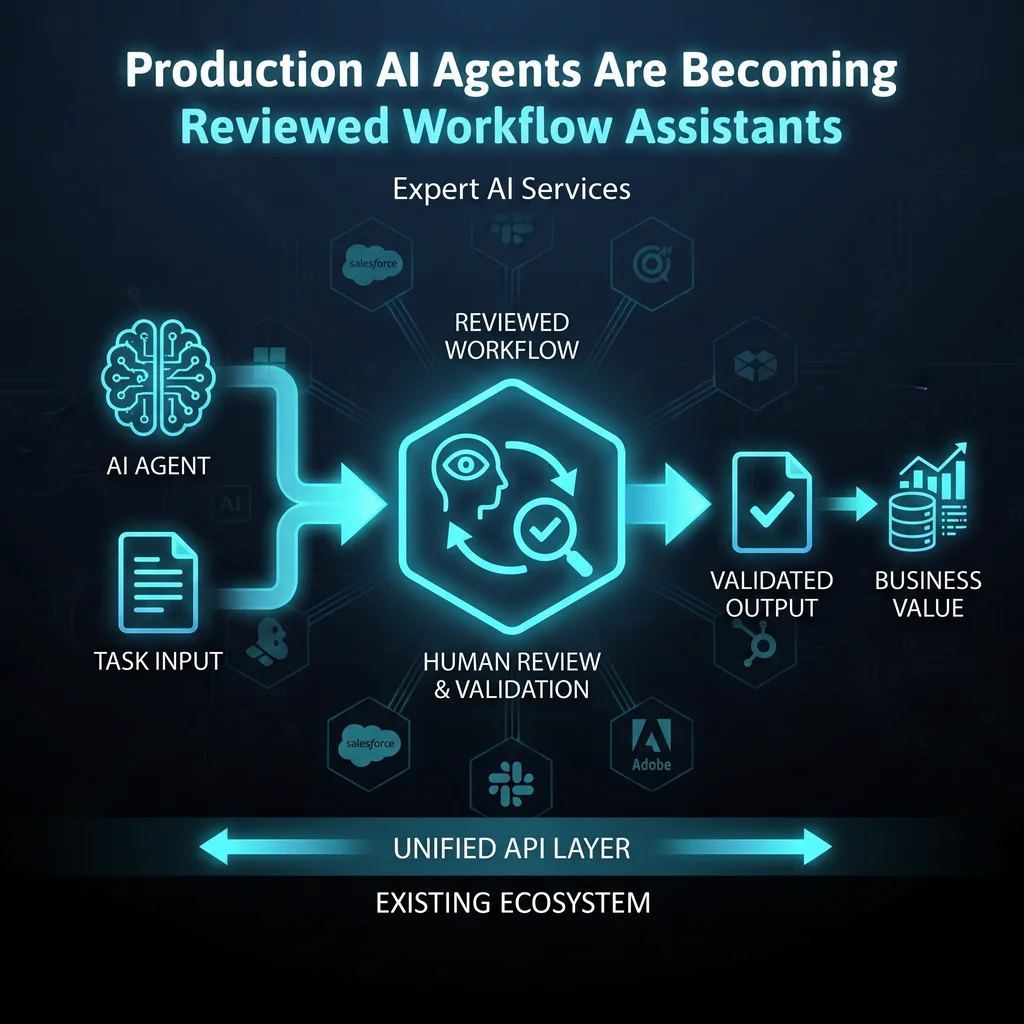
The loudest claims around AI agents still make them sound like digital employees waiting to run entire departments. That is not what most production use looks like for small businesses. The practical pattern is narrower and more useful: agents are becoming reviewed workflow assistants that prepare work for people who still make the calls.
For Kansas business owners and operators, that distinction matters. A shop owner, dispatcher, service manager, or founder does not need more software clutter. They need fewer repeated steps, fewer missed handoffs, and better visibility into the work already moving through the business.
In production, agents are showing up where a workflow already has a pattern: support triage, FAQ answers, voice lead qualification, repeat research, daily searches, and internal task execution. That is not the same as handing the business to software. It is closer to giving a capable coordinator a checklist, a narrow set of tools, and a human reviewer.
The difference matters. A fully autonomous worker would decide, act, and move on without a person checking the outcome. A reviewed workflow assistant drafts the response, gathers the record, labels the lead, updates the task, or prepares the next step. Then a technician, office manager, estimator, or owner approves, edits, or rejects the work.
For most small businesses, the near-term win is not an agent that runs the company. It is an agent that gets the next reviewed step ready before the person in charge has to ask.
Owners and operators are focusing on work that is repetitive enough for automation but important enough to review. Support questions, scheduling requests, product FAQs, lead notes, document lookups, and daily research all fit that pattern. These jobs burn time because they scatter across inboxes, forms, chats, spreadsheets, PDFs, and CRM records.
An AI agent can reduce that switching. It can read the incoming request, pull from approved knowledge, summarize the needed context, and prepare a suggested action. The human still decides what leaves the building. That balance is especially useful in Kansas service businesses, where customer trust often depends on a real relationship, not just a fast reply.
In controls, BAS, low-voltage, field coordination, construction, ecommerce support, and local professional services, the messy part is usually not one big decision. It is the pile of little handoffs. Someone needs to know which drawing changed, which customer asked for a callback, which ticket needs escalation, which quote is waiting on a detail, and which vendor answer should be copied into the right place.
That is where custom AI services can be useful. The agent does not need permission to be dramatic. It needs access to the right slice of information, a clear job, and a review path. A lead qualification agent can organize caller details before sales follows up. A knowledge-base assistant can draft answers from approved material. A research agent can check the same sources every morning and surface changes. A document agent can pull structured details from files so a coordinator does not retype them.
Some teams treat review as a weakness because it means the system is not fully hands-off. That misses the point. Review is how businesses protect customer promises, credentials, pricing, safety, and brand judgment. The agent should make the review faster and better, not disappear the reviewer.
A strong reviewed workflow has visible inputs, visible reasoning, and visible next steps. It shows what information the agent used, what it is recommending, and where a person can correct it. When that pattern is in place, managers can spot bad assumptions before they turn into customer-facing mistakes.
If you run a small team, the first question should not be whether an AI agent can do everything. It should be which reviewed task is costing your people time every week. Look for work with a stable pattern, clear source material, and an obvious approval owner. Good candidates include inbound FAQs, internal lookup requests, repeat research, customer intake summaries, quote-prep notes, and document extraction.
The second question is where the agent should stop. For example, it may classify a lead but leave pricing to a salesperson. It may draft a support reply but require approval before sending. It may search business systems but avoid changing records until a coordinator confirms the update. These boundaries keep the workflow useful without asking employees to trust a black box.
This is also why model-agnostic stack decisions matter. Production workflows should not be trapped inside one demo tool. They need to connect to the systems already carrying the work, use the right model for the job, and keep enough logging for review. Less software, more useful workflows is the practical goal.
Expert AI Services looks at AI through the lens of people who have had to make real operations run: controls, BAS, low-voltage, field coordination, and the daily pressure of keeping work moving. That background changes the design question. The goal is not to impress someone with a flashy agent. The goal is to remove manual logging, repeated lookups, and tool overload while keeping people in charge of the customer relationship.
For readers getting to know the team, the Expert AI Services background explains why local-first implementation matters. Proof matters too. Products like SMSai show how applied automation can support real customer communication without asking a small business to rebuild every system at once.
A good first project is usually narrow: one workflow, one owner, one approval loop, and one measurable source of time savings. Once that works, the agent can expand carefully. The pattern stays the same: AI prepares the work, people review the important parts, and the business gains capacity without losing control.
The industry news is practical, not futuristic. Production AI agents are becoming reviewed workflow assistants, not fully autonomous workers. That is good news for Kansas owners who need results they can trust. The businesses that benefit first will be the ones that give agents focused jobs, clear boundaries, approved knowledge, and accountable human reviewers.
If your team is buried in repeated questions, daily searches, intake notes, or document lookups, this is the right moment to evaluate where reviewed automation belongs. Talk with an AI integration lead about a custom AI services plan that simplifies the work without taking judgment away from the people who know the business.
Source
Kansas Impact
Key Takeaway