
AI agents are moving out of demos and into the everyday software that runs a business: CRM records, ad accounts, shared files, finance tools, inboxes, and reporting dashboards. For Kansas owners and operators, the practical question is no longer only which model sounds smartest. It is which systems the agent can read, which systems it can change, and who approves the change before it affects a customer, a dollar, or a record.
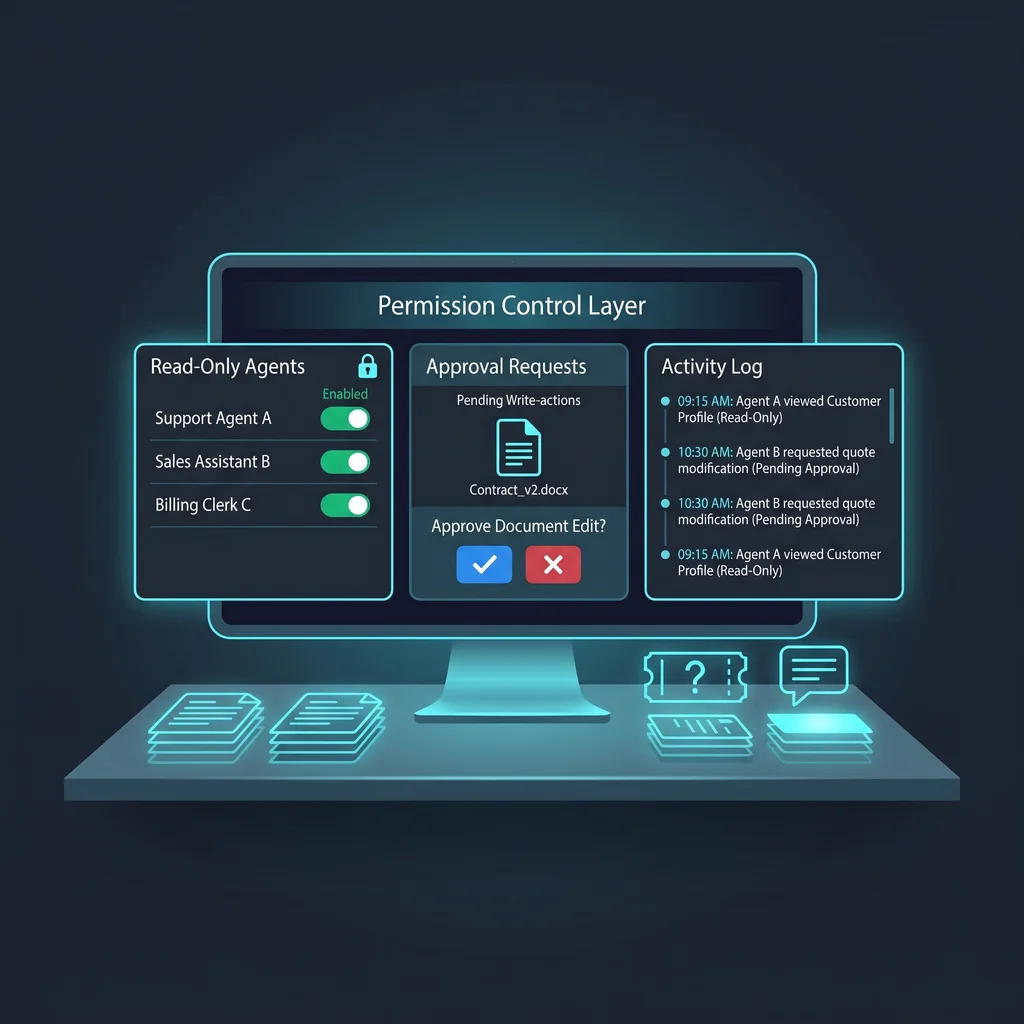
That is why AI agent governance should start with read-only access. Read-only agents can gather context, summarize work, spot missing information, draft next steps, and prepare clean handoffs without changing the source system. They give the team useful leverage while keeping the final action in human hands until the workflow is proven.
Recent ACM CAIS research on tool-using agents makes the point plain. The paper studied runtime enforcement against unsafe actions in multi-step agent workflows and found that safety mediation can intercept many non-compliant actions, but blocking unsafe moves does not automatically produce safe task completion. In other words, a guardrail is necessary, but the operating design around identity, permissions, approval, and recovery still matters.
The practical AI safety question is not only whether the model is accurate. It is what the agent is allowed to touch.
Read-only access sounds modest, but it is one of the most useful patterns in AI tool permissions. A read-only agent can inspect a customer record, compare a quote against a shared price sheet, summarize a call note, or flag a missing follow-up. It can do the thinking work around the record without editing the record.
A good first step is to list the places where an agent needs visibility. For many small businesses, that means customer history, open tasks, shared documents, recent emails, marketing performance, and invoice status. The agent does not need permission to update every one of those systems on day one. It needs enough read access to prepare a useful recommendation.
Write access should be treated as a separate decision. Updating a CRM stage, sending a customer message, changing an ad budget, creating an invoice, or marking a task complete are not the same risk. Read-only AI agents can draft those actions first. Then agent approval workflows can route the proposed change to the right person before anything is committed.
Approval gates are important, but they are not a substitute for permission design. If an agent can touch too many systems, every approval prompt becomes harder to trust. The reviewer has to inspect not only the suggested action, but also whether the agent had any reason to be in that system at all.
The better pattern is layered. First, define the agent identity. Second, limit the tools and data it can access. Third, make read-only the default. Fourth, require approval for write actions. Fifth, record the decision in an AI audit trail. That structure turns approval from a last-minute pause into part of the workflow.
This matters for ordinary operations. A sales coordinator may want an agent to review stale opportunities and suggest follow-ups. A bookkeeper may want an agent to compare invoice notes against payment status. An owner may want a weekly summary of ad spend and lead quality. Those are useful workflows, but they should not give the agent broad authority to edit records, send messages, or move money without a clear approval step.
Kansas small businesses often run lean. One person may handle sales follow-up before lunch, vendor questions after lunch, and reporting at the end of the day. AI can reduce that manual switching, but only if the setup respects how the work actually gets done.
Start with a permission map. For each system, write down three things: what the agent may read, what it may propose, and what it may change after approval. CRM records may allow read access and drafted updates. Ad accounts may allow read access and budget recommendations, with human approval before changes. Finance tools may allow status checks and report preparation, while payments and account changes stay human-approved.
This is where a local, practical partner helps. Expert AI Services builds custom AI services around the real workflow instead of forcing another piece of software into the day. The goal is less software, more useful workflows. For a trust anchor on the team behind that approach, Kansas operators can start with the Expert AI Services local team.
An AI audit trail should do more than save a chat transcript. It should show which agent identity made the request, which tool was called, what data was accessed, whether the action was read-only or write-capable, who approved it, and what happened after approval. That record makes the workflow reviewable when something looks off.
The useful log entry is not just a note that the agent completed a task. It is closer to this: the agent read these records, proposed this change, approval came from this person, and this system accepted the update. That level of detail helps an owner separate a bad recommendation from a bad permission setup.
The secure-agent proxy pattern points in the same direction. Earl, an open-source project referenced in the FlashClaw evidence, places templates and secrets outside the prompt path so the agent supplies parameters without seeing the underlying request body or credentials. The broader lesson is simple: AI tool permissions should be explicit, reviewable, and separated from the conversation wherever possible.
For most operators, the first version should be boring on purpose. Give the agent read-only access to one workflow. Ask it to summarize, compare, and draft. Review its suggestions with the people who already own the work. When the recommendations are consistently useful, add a narrow approval path for one write action.
That is also how product proof should be judged. SMSai, Expert AI Services' SMS automation example, is useful because messaging workflows need clear boundaries, handoffs, and accountability. The same thinking applies when an agent reads a CRM or drafts a customer follow-up. Owners can explore the applied approach at SMSai.
The next stage of AI agent governance is not giving agents wider access because they can do more. It is giving them the smallest useful permission set, watching what happens, and expanding only when the audit trail proves the workflow is reliable. For Kansas businesses, that is the steady path: start read-only, approve writes, log the work, and keep people in charge of the decisions that matter.
Source
ACM research on tool-using agents, with secure agent-proxy implementation signal
Kansas Impact
Kansas small businesses adopting AI for CRMs, ad accounts, files, and finance tools need permission boundaries before allowing agents to take actions.
Key Takeaway
The practical AI safety question is not only model accuracy; it is what the agent is allowed to touch.