
Competitor research gets messy fast for a local service business. A new offer may appear on a competitor website. A pricing page may change language. A promotion may run for one week and disappear before the owner has time to compare it against their own sales plan. When those updates are checked only when someone remembers, market awareness becomes a side job instead of a reliable operating rhythm.
This case-style scenario shows how AI competitor monitoring can turn that scattered work into a weekly review queue. The client is a scenario client: a local service business. The problem is straightforward: competitor updates, pricing changes, and new offers are checked inconsistently. The solution is to schedule an AI-assisted monitoring run that summarizes source-backed changes into a review queue. The result is a weekly market-change brief the owner can review without relying on unapproved AI conclusions.
Most small business owners already know they should keep an eye on the market. The hard part is doing it consistently while still handling calls, estimates, service delivery, hiring, billing, and customer follow-up. A competitor may update a landing page on Tuesday, change an offer by Friday, and test new wording the next month. None of those changes may justify an immediate response, but missing all of them leaves the business reacting late.
For this scenario client, the issue was not a lack of curiosity. It was the lack of a repeatable process. Someone would check a few websites, paste notes into a document, and bring up a change during a meeting. Another person might remember a different competitor update but not have the source handy. That makes it hard to separate real market movement from a one-off observation.
Competitor updates can affect how a business frames value, trains sales staff, and answers customer objections. But those decisions should not come from an AI summary by itself. They need source URLs, review status, and a clear owner approval step. That is the difference between helpful competitor research automation and a pile of unverified claims.
AI should help a business see what changed, where it changed, and what needs a human decision next.
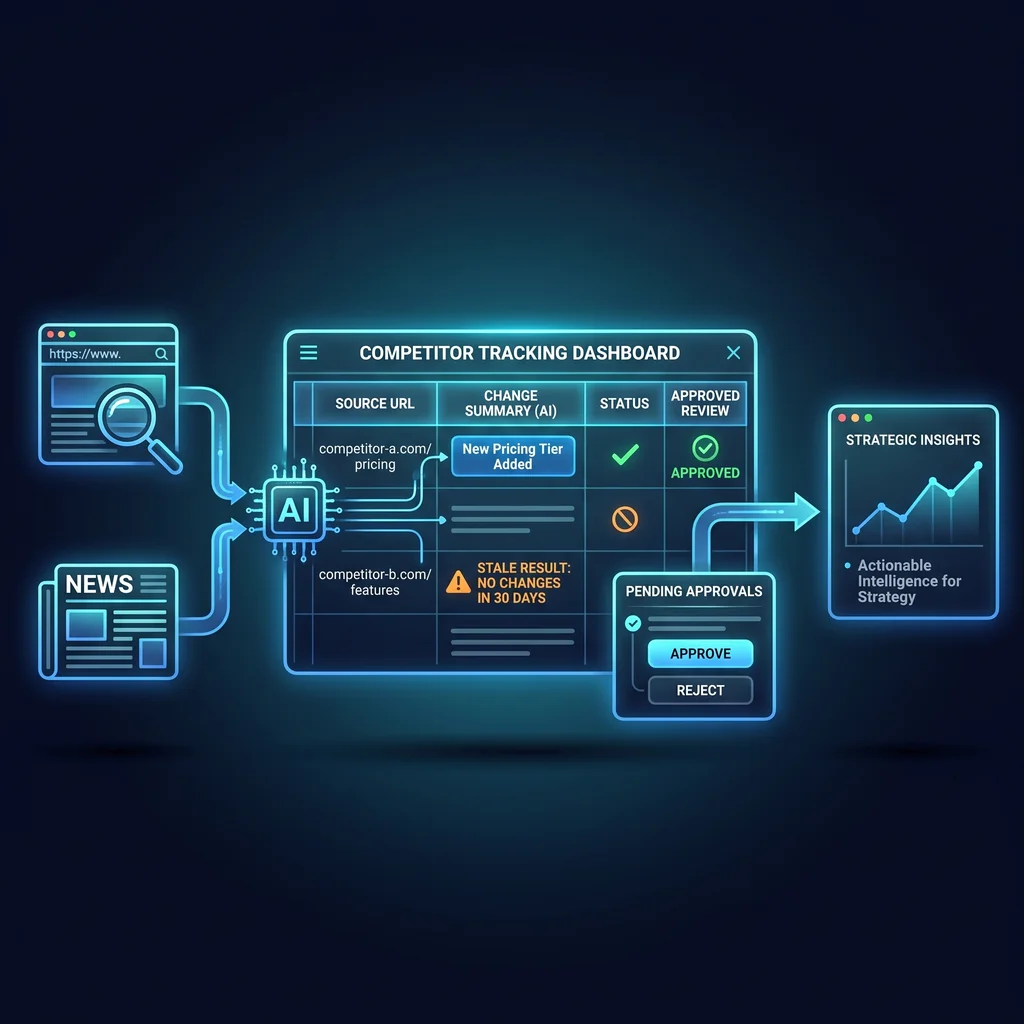
The workflow starts with a narrow watch list. Instead of asking an AI agent to research the whole internet, the business identifies the competitor pages and offer pages that matter most. The scheduled run checks those sources on a defined cadence, summarizes visible changes, and places each finding into a review queue with the source URL attached.
This keeps the tool focused. The AI is not asked to decide whether the business should change pricing. It is asked to collect evidence, summarize the visible change, and mark the item for review. That gives the owner or operator a practical weekly brief: what changed, where it came from, whether the result looks stale, and whether someone has approved it.
A useful review queue should include the competitor name, source URL, observed change, previous note if available, date checked, stale-result warning, and approval status. The approval status matters because it keeps AI sales research from slipping directly into customer-facing language. A sales manager can approve a finding, reject it, or ask for a follow-up check before the team changes its messaging.
This is also where a model-agnostic stack helps. The business can keep the workflow focused on durable outputs: a spreadsheet, a review inbox, a weekly brief, or a CRM note. The model is only one part of the system. The useful part is the operating pattern that makes the information easier to trust.
OpenAI's Codex automation guidance supports scheduled runs, triage, manual testing before scheduling, sandbox awareness, and first-output review. The same idea applies here. Before a recurring competitor report becomes part of weekly operations, the first output should be checked carefully. Did the run look at the right pages? Did it cite sources? Did it confuse a stale page with a new offer? Did it produce a useful summary, or just a long list of noise?
That first review protects the business from treating automation as certainty. It also gives the owner a chance to tune the workflow. If the queue is too broad, reduce the source list. If the findings are too vague, require a change summary and a direct source URL. If the workflow misses key pages, update the watch list before scheduling the next run.
For Kansas business owners and operators, this kind of practical review step fits the way decisions already get made. People want useful information, but they also want to know where it came from. A weekly market-change brief should make the next conversation easier, not create another software chore.
Expert AI Services builds custom AI services around the work a business actually needs done. In this case, the work is not broad market research. It is recurring small business market monitoring with review queue automation. That means the design should stay plain: source checks, summarized changes, approval labels, and a weekly brief the owner can scan quickly.
The same applied approach shows up in product work like SMSai, where automation supports communication without asking a team to babysit more software. For businesses evaluating AI partners, the local Expert AI Services team is a useful trust anchor because the goal is not novelty for its own sake. The goal is less software clutter and more useful workflows.
A good competitor-monitoring workflow should end with a human decision. The AI can watch, summarize, and organize. The owner still decides what matters, what to ignore, and what to change. That balance is what makes the system practical for a working business.
The expected result for the scenario client is a weekly market-change brief that does not rely on unreviewed AI conclusions. The owner can scan the queue, open source links, approve relevant findings, and decide whether any sales or pricing follow-up is needed. The business gains a steadier view of competitor movement without turning every update into an emergency.
That is the practical value of AI competitor monitoring. It does not replace judgment. It gives judgment a cleaner place to work.
Client Type
Scenario client: local service business
The Problem
Competitor updates, pricing changes, and new offers are checked inconsistently.
The Solution
Schedule an AI-assisted monitoring run that summarizes source-backed changes into a review queue.
Result
Owner gets a weekly market-change brief without relying on unreviewed AI conclusions.
Result
Result
Conclusion