
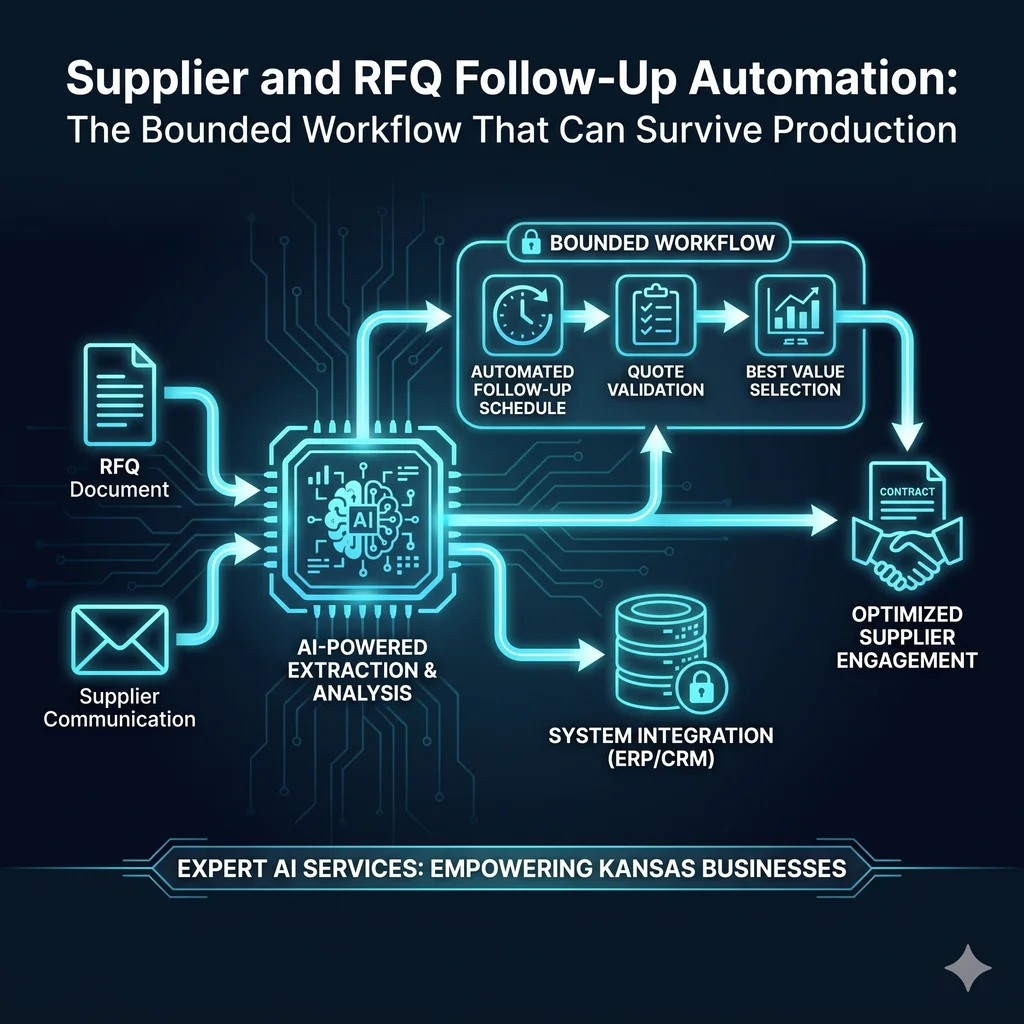
Supplier and RFQ follow-up is one of those office jobs that looks simple from the outside and gets messy the minute real work hits it. A coordinator sends a request for quote, waits on a supplier, checks whether the quote includes the right part numbers or scope notes, follows up again, updates the team, and tries not to lose the thread while customers, technicians, and deadlines keep moving.
That is exactly why it can be a strong automation candidate. It is repetitive, but it is not trivial. It has clear steps, but it still needs judgment. For Kansas business owners and operators, the question is not whether an AI agent can write a follow-up email. The better question is whether supplier and RFQ follow-up automation can be bounded tightly enough to survive production without creating extra review work.
A reliable automation project starts with a small lane. In this case, the lane is not purchasing strategy, supplier negotiation, or final approval. The lane is follow-up coordination: spotting stale RFQs, identifying missing information, preparing draft nudges, and routing questionable cases to a person.
That matters because partial reliability has a cost. An automation that works most of the time can still be too expensive if staff have to reread every detail, correct tone, hunt for missing context, or undo messages that should never have been sent. A bounded workflow earns its place by making review easier, not by asking the team to trust a black box.
A practical RFQ follow-up loop can monitor a known list of open requests, check the last supplier response date, compare the request against expected fields, and prepare a draft message when something is overdue or incomplete. It can flag missing delivery dates, unclear substitutions, absent freight notes, or mismatched quantities. It can also group similar follow-ups so the purchasing or operations lead reviews a clean queue instead of bouncing between email, spreadsheets, and job notes.
The workflow should use approved templates and plain language. For example, the draft might say that the team is checking on an open quote, list the specific missing item, and ask whether the supplier can confirm by a certain date. That is useful because it saves the coordinator from rewriting the same polite nudge ten times. It is also bounded because the AI is not changing the deal, committing to a price, or promising the customer anything.
Good automation does not take the relationship away from the operator. It keeps the routine work organized so the operator can protect the relationship with better timing and clearer context.
Supplier relationships carry local knowledge. A Kansas contractor, manufacturer, service company, or building-systems team may know which vendor needs a phone call, which quote requires a second set of eyes, and which supplier always uses different language for the same part. That kind of context should not be flattened into an automatic send button.
Human approval belongs anywhere the message could affect price, scope, schedule, or trust. If a draft changes terms, references a customer deadline, mentions a substitute, or interprets a supplier note, it should land in an exception queue. The same goes for incomplete records, new suppliers, unusually high values, or RFQs tied to sensitive projects.
An exception queue is where production workflows get real. Instead of forcing every item through the same review, the automation separates routine follow-ups from cases that need judgment. A coordinator can approve normal drafts quickly, while the operations lead handles anything with pricing exposure, scope ambiguity, or relationship risk.
This is the same practical mindset behind Expert AI Services' work: less software, more useful workflows. The team brings building-systems experience across controls, BAS, low-voltage, and field coordination, which shapes how automation is designed. Real operations are not clean demos. They involve field notes, vendor habits, customer pressure, and staff who already have enough screens open. You can learn more about that local background on the Expert AI Services about page.
A supplier follow-up workflow is ready for production when it can show its work. The reviewer should see which RFQ triggered the draft, what supplier record was used, when the last response came in, what information appears to be missing, and why the item is routine or exceptional. If the system cannot explain that clearly, it is not ready to run in the daily flow.
The workflow also needs limits. It should know which suppliers are in scope, which message templates are approved, which data sources are trusted, and which actions require approval. It should keep logs so owners can review what happened when a question comes up. It should also fail quietly and visibly: if the data is incomplete, it should ask for review instead of guessing.
For most small businesses, the first production version should draft rather than send. Draft-only automation still saves time because it gathers context, writes the first pass, and moves the task into a review queue. Once the team sees consistent quality, some low-risk follow-ups may become eligible for one-click approval or narrow auto-send rules. That decision should come after observation, not before.
This is where proven applied AI matters more than broad promises. Expert AI Services points to tools like SMSai as an example of focused automation: a specific communication workflow built to reduce manual back-and-forth while keeping the business use case clear. RFQ follow-up should be treated the same way. Define the job. Bound the permissions. Review the outputs. Improve the loop.
Kansas businesses often run on lean teams and long-standing relationships. The person chasing RFQs may also be answering customer questions, coordinating technicians, reviewing schedules, and helping keep jobs moving. A good AI agent should respect that reality. It should remove manual logging and reminder clutter without pretending to replace the people who understand the work.
The best first step is a workflow review. Pick one RFQ category, map the current follow-up path, list the normal cases, and define the exceptions. Then decide what the agent can draft, what it can flag, and what must stay human. That bounded approach is how supplier and RFQ follow-up automation becomes durable enough for production instead of becoming another tool the team has to manage.
For owners and operators evaluating custom AI services, the goal is simple: build a workflow that helps staff follow up faster, miss less, and protect supplier trust. When automation stays narrow, visible, and reviewable, it can become a steady helper in the daily operating rhythm.
Process Type
Time Saved
Tools Used
Before
After