
AI agents are getting good enough to help with real office work. They can prepare follow-up notes, check customer records, draft internal updates, create tasks, and move information between systems. For Kansas business owners and operators, that is useful only if the automation stays under control.
The risky version is easy to spot. One agent gets a direct key to the CRM. Another script reaches the inbox. A third workflow has access to billing, files, or project records. Each piece may work on its own, but the whole setup becomes hard to govern. Credentials scatter. Logs live in different places. Review rules depend on whoever built the last automation.
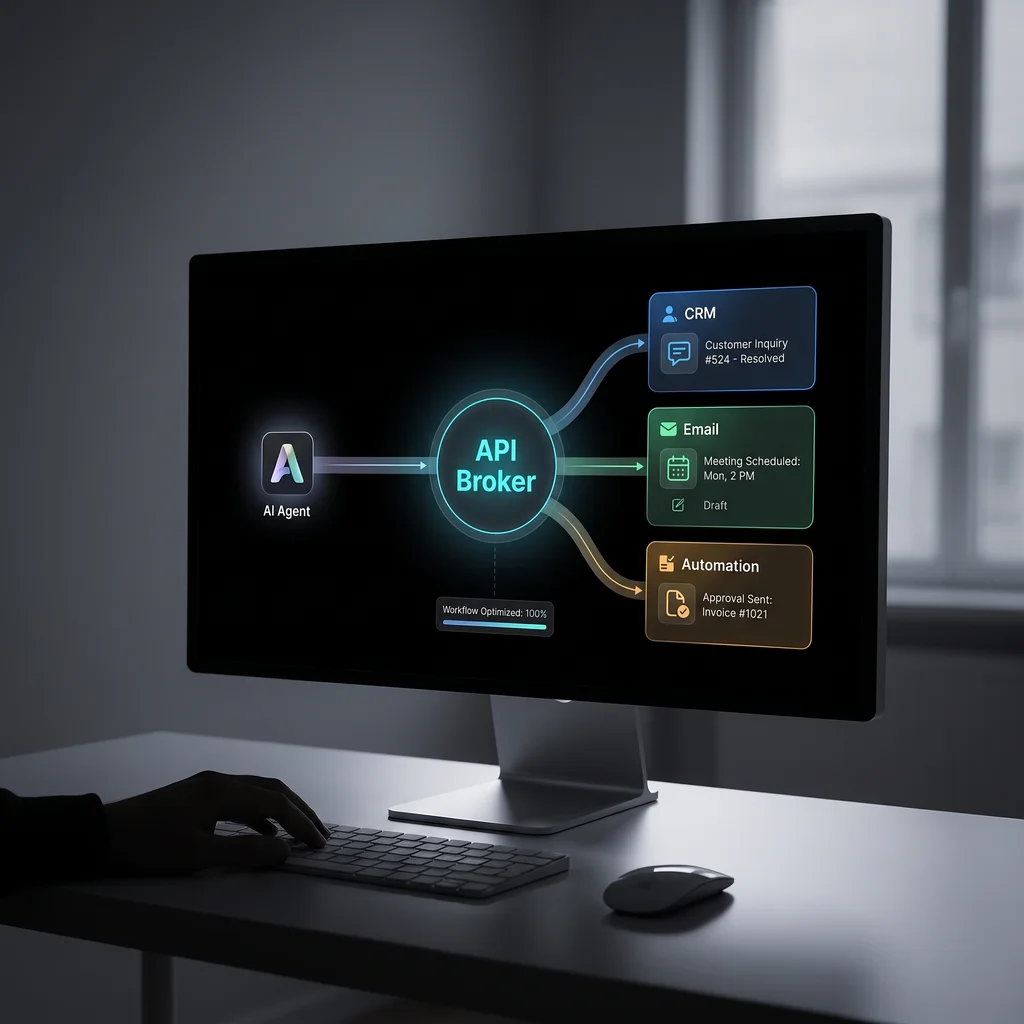
An AI API broker gives the business a better pattern. It sits between AI agents and business tools, then routes requests through shared rules, permissions, logs, and recovery steps. Instead of asking whether an agent can technically call an API, the broker asks the more useful question: should this action happen, under what conditions, and how will the business know what changed?
Direct access is tempting because it is quick. A small business wants the agent to create a task, update a record, or send a message, so the easiest path is to connect the tool and move on. That approach can be fine for a narrow test. It becomes a problem when the same pattern spreads across departments, vendors, and repeat workflows.
Once agents or scripts call individual tools directly, every connection becomes its own little policy decision. Who owns the API key? What can the agent read? What can it write? Does the request need human review? Where is the action logged? What happens if the agent sends the wrong update or receives incomplete data?
Agent automation gets safer when tool access becomes a governed business process, not a pile of one-off connections.
This is where an AI API broker earns its keep. The broker becomes the front door for tool calls. Agents ask the broker for an approved business action, and the broker handles the actual API call according to rules the business can understand.
A practical broker does not need to be fancy at first. It needs to centralize the pieces that become painful when they are spread across disconnected automations. That starts with credentials. Agents should not need their own long list of direct keys for every SaaS product. The broker can hold and rotate access in one controlled place.
The next layer is endpoint rules. A customer service helper may read customer status but not change payment terms. A sales follow-up workflow may create a draft message but not send it without approval. A back-office automation may prepare invoice notes but not post final accounting changes. Those limits are easier to manage when the broker enforces them consistently.
The best broker pattern is not built around raw API endpoints. It is built around business actions. Instead of exposing every possible CRM endpoint, the broker can offer actions such as create follow-up task, look up customer status, draft renewal note, or attach intake summary. That keeps AI agents for business focused on work the team recognizes.
This also helps with MCP automation. MCP-style connectors can make tools easier for agents to reach, but connection is not the same as governance. A broker layer can sit between the agent and those connectors so access still passes through business rules, request shaping, logging, and review thresholds.
Open source projects such as Earl reflect the growing developer focus on giving agents structured access to outside tools. For a small business, the takeaway is practical: do not stop at giving the agent a tool. Decide how tool access should be controlled before the workflow becomes part of daily operations.
Picture a local company that wants an agent to help with customer follow-up. The before state is scattered: one script checks a form tool, another touches the CRM, another drafts email, and someone keeps a manual note of what happened. The work may save time, but it is fragile. If a customer record changes unexpectedly, the team has to hunt through several systems to understand why.
With a broker in place, the agent sends a request such as prepare follow-up for this customer. The broker checks the allowed action, pulls the needed record, formats the request, drafts the update, logs the event, and asks for approval if the action crosses a threshold. The after state is cleaner: one controlled path, shared rules, visible logs, and recoverable steps.
That is the kind of custom AI services work that fits real operations. It is not about adding more software for its own sake. It is about reducing manual toil while keeping business owners, coordinators, and team leads confident about what the automation is doing.
The first build should be narrow. Choose a process that happens every week, uses information from more than one system, and creates enough manual follow-up to be worth improving. Intake routing, customer status checks, quote follow-up reminders, internal task creation, and handoff summaries are all reasonable candidates.
Write the broker rules before writing the automation. List what the agent may read, what it may change, what requires approval, what should be logged, and what should stop the workflow. That plain-language contract becomes the starting point for business API automation and agent workflow security.
For many teams, the early win is not dramatic. It is steadier work. Repeat workflows become easier to track. Credentials are less scattered. Review is less dependent on memory. The time saved may be modest at first, but after repeat workflows are brokered and logged, three to five hours per week can become realistic for the right office process.
Expert AI Services helps businesses turn useful AI ideas into working systems with rules, handoffs, and measurable value. Our local-first approach matters because the best automation starts with how your team already works, not with a generic demo.
Applied products like SMSai show the same principle in a focused form: use AI to simplify communication and reduce manual work while keeping the process understandable. An API broker follows that same mindset for broader tool access. It gives agents a controlled way to reach the systems your business already depends on.
If your team is ready to explore AI agents, start with the control layer. Decide how requests move, where logs live, when humans approve actions, and how mistakes get recovered. Then connect the tools. That order gives Kansas operators a cleaner path from experiment to dependable workflow automation.
Explore how custom AI services transform operations, or talk with an AI integration lead about the first workflow worth brokering in your business.
Process Type
API-connected business automation
Time Saved
3-5 hours per week after repeat workflows are brokered and logged
Tools Used
API broker, MCP-style connectors, SaaS APIs, automation logs
Before
Agents or scripts call individual tools directly with scattered credentials and inconsistent review.
After
Agent requests pass through one controlled broker with shared rules, logs, and recoverable actions.