
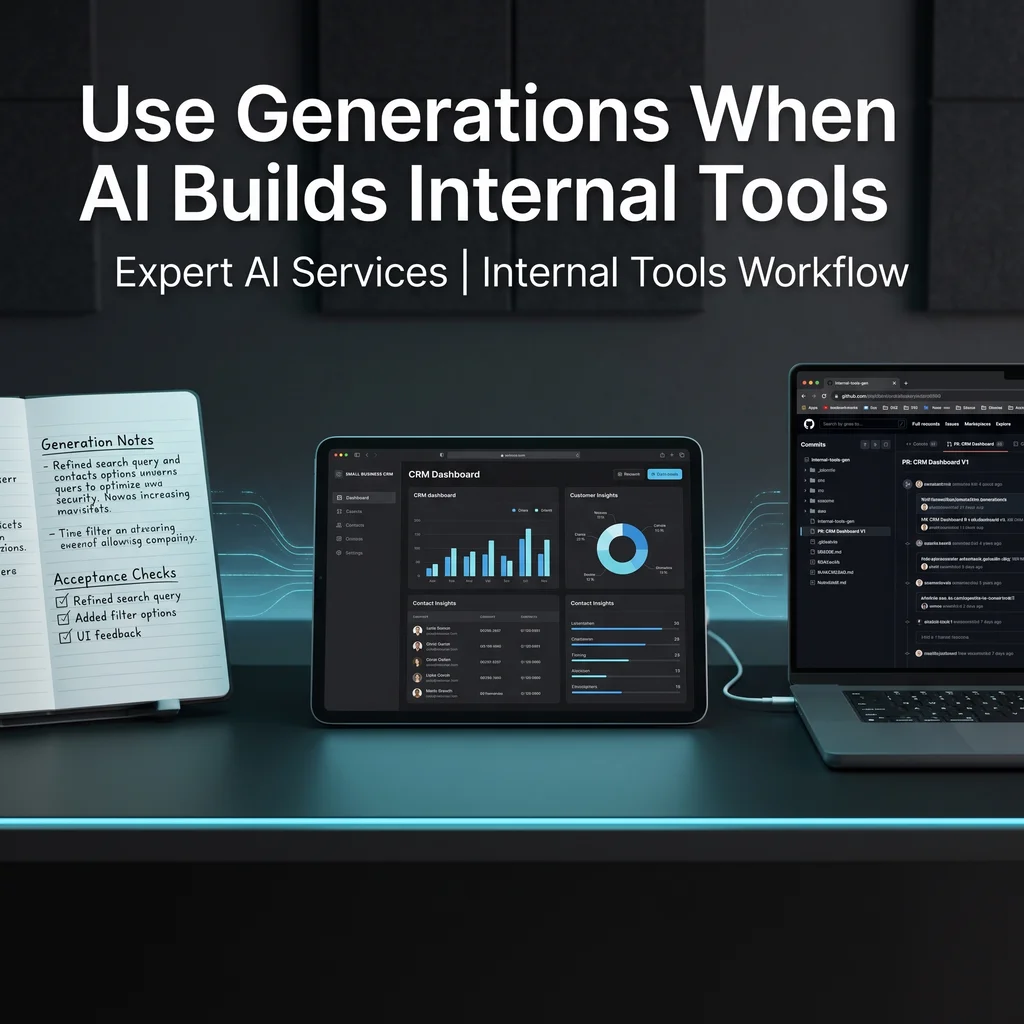
Small business software work has changed fast. A Kansas owner, office manager, or operations lead can describe a quote tracker, lightweight CRM, inventory view, scheduling board, or admin panel and get a working internal tool prototype much faster than before. That speed is useful. It also creates a new responsibility.
The first working version can feel more finished than it really is. Buttons click. A screen loads. A table saves data. But that does not mean the tool is ready for daily use, staff training, customer follow-up, or owner-level decisions.
For AI internal tools for small business, the problem is not usually that the first prototype has no value. The problem is that it may become trusted before the workflow, permissions, edge cases, and handoff notes have been checked. That is why Expert AI Services frames this composite case study around generations instead of one-shot prototyping.
Many small businesses are experimenting with AI-assisted building. Some call it vibe coding. Others describe it as using AI to create small business software without waiting months for a traditional project. Either way, the pattern is familiar: a person describes what they want, an AI coding tool produces an early version, and the team starts imagining how it could replace a spreadsheet or manual tracker.
That early momentum is helpful, but it can hide important gaps. The prototype may not match the way the team actually works. It may store the wrong fields, skip a required review step, or make sense only to the person who prompted it. If that person is busy, leaves the company, or cannot explain the logic, the tool becomes another unsupported app.
Internal tools should earn trust generation by generation, not by looking finished on the first pass.
This ExpertAI composite method case study starts with a practical operator problem: teams can generate tools quickly, but they lack a clear review loop before relying on them. The source signal for this article includes the public REAP project and site, which support a generation-based software development method rather than a prompt-once-and-ship mindset.
The method is simple. Treat each AI-assisted build pass as a generation. After every generation, record what changed, what was accepted, what failed review, and what should happen next. That turns the internal tool prototype into a managed backlog instead of an orphaned experiment.
A generation note does not need to be long. It should explain the request, the change made, the visible result, and any known concern. For example, a CRM dashboard generation might add lead status filters, but the note should also say whether the filter logic was reviewed against real sales follow-up steps.
This matters for operators because the next person should be able to understand the tool without replaying every prompt. Clear notes also make it easier for a technical partner to inspect what happened and decide whether the next generation should improve the interface, data model, workflow, or handoff documentation.
Each generation should answer a practical question. Does the tool match the workflow people already follow? Does it reduce duplicate entry? Does it show the right information at the right time? Can a staff member recover when something goes wrong? Does the owner know what information is reliable and what still needs review?
A strong AI coding workflow does not treat working code as the finish line. It treats working code as something to inspect. Acceptance checks can include required fields, role access, mobile usability, export behavior, error messages, customer record accuracy, and whether the tool still works when the data is messy.
Acceptance checks are not corporate paperwork. They are a way to protect the people who will depend on the tool. A coordinator should not have to guess whether a customer record saved correctly. A founder should not have to wonder whether a report includes every open lead. A manager should not need to ask the AI tool what changed because the handoff should already say so.
For Kansas businesses, this is especially important because lean teams often have one person covering several roles. A lightweight review loop keeps AI useful without adding software clutter.
Vibe coding can be a good way to get an idea out of someone's head and onto a screen. It should not be the whole operating model. A generation-based process keeps the creative speed while adding enough discipline to make the result useful.
The backlog should separate ideas from accepted work. One item might say the dashboard needs a customer search field. Another might say the export needs to include date range filters. Another might say login behavior has not been reviewed. That distinction helps the business avoid treating every visible feature as finished.
This is where a partner such as Expert AI Services can help. The work is not just building a screen. It is helping the business decide what should be automated, what should be reviewed, and what deserves to become part of daily operations.
A generation is not complete until someone can hand it off. The handoff should say what the tool does, what changed in the latest pass, which checks were completed, what risks remain, and what the next generation should address. That makes future development easier and keeps the business from relying on memory.
Expert AI Services favors custom AI services that simplify work instead of adding another system people have to babysit. Products and workflows like SMSai show the same applied mindset: AI should help teams communicate, coordinate, and reduce manual toil in ways they can understand.
The practical lesson is clear. If AI is building internal tools, do not stop at the first impressive prototype. Use generations. Review each pass. Write down what changed. Keep an acceptance checklist. Build a backlog that a real operator can trust.
That is how an AI-built prototype becomes useful small business software instead of a one-off app no one wants to own.
Client Type
ExpertAI composite method case study
The Problem
Operators can generate tools quickly but lack a clear review loop before relying on them.
The Solution
Use generation notes, acceptance checks, and handoff documentation after each AI-assisted build pass.
Result
The prototype becomes a reviewed internal tool backlog instead of an unsupported one-off app.
Result
Result
Conclusion