
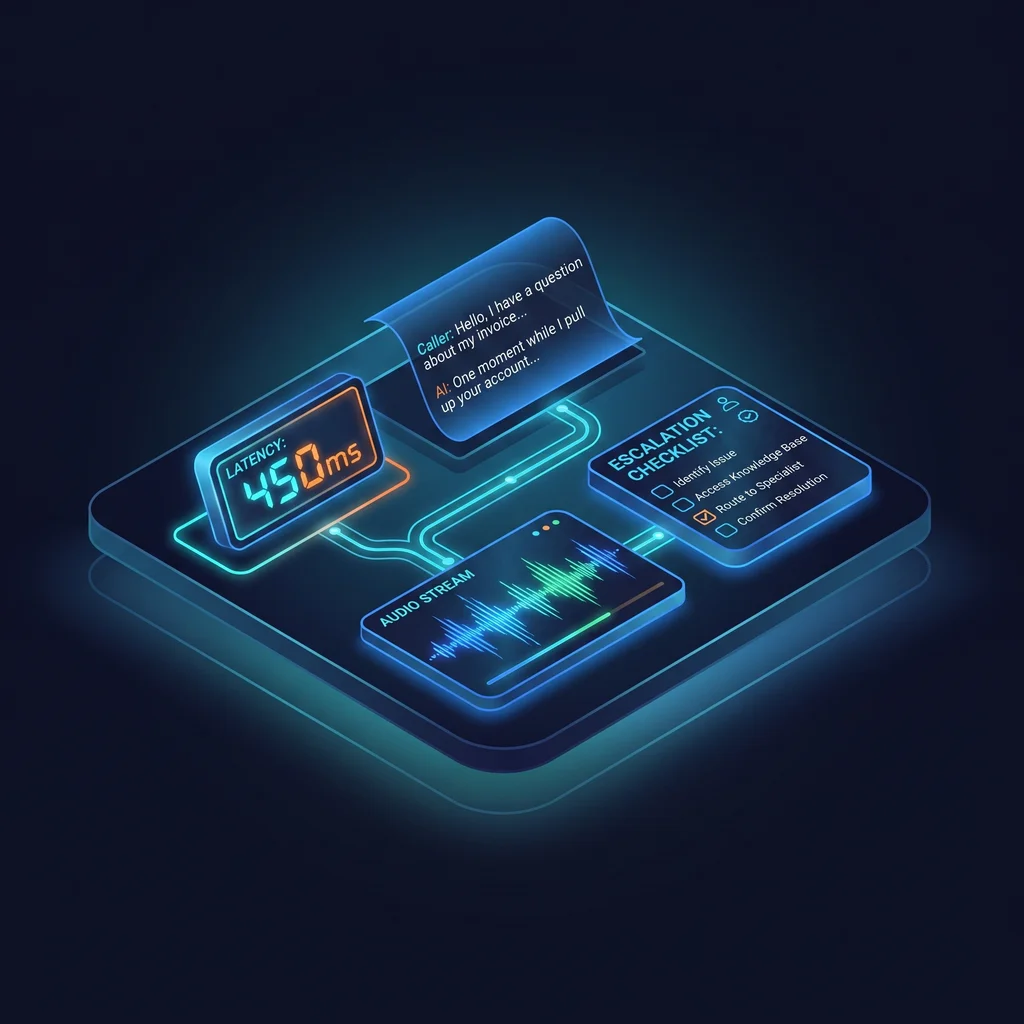
Voice agents are getting good enough that small businesses are starting to ask a practical question: can we let one answer real customer calls? For a Kansas owner or operator, that question should not start with the voice, the script, or the demo. It should start with voice agent latency.
Latency is not just a technical delay hidden in the background. On a phone call, it is part of the customer experience. A caller notices the pause after they speak. They notice when the AI voice agent talks over them, misses an interruption, or takes too long to decide whether to answer or escalate. Even a polished voice can feel unhelpful if the timing is wrong.
This case study uses a composite small-business support desk. The situation is common: customer service automation sounds useful, call volume can be uneven, and the team wants fewer repetitive interruptions. The risk is also common. If slow responses or poor turn-taking frustrate callers, the business may lose trust faster than it saves time.
Before a voice agent handles customer calls, the business needs a latency budget that defines how fast each part of the conversation must feel.
The source material for this article focuses on the orchestration quality behind voice agents: latency, turn detection, interruption handling, and customer experience thresholds. That is the right starting point because a voice system is not one model. It is a chain of services that must work together in real time.
When a caller speaks, speech-to-text has to capture the words. The language model has to decide what the caller likely wants. The system may need to check business rules, customer context, or escalation conditions. Text-to-speech then has to produce an answer that sounds natural enough to continue the conversation. If the caller interrupts, the system has to stop, listen, and recover.
That full loop is what makes voice AI readiness different from a chat workflow. In chat, a short delay can be acceptable. On a call, silence feels heavier. A half-second here and another pause there can make the caller wonder whether the line dropped, whether the system understood, or whether they need to repeat themselves.
A latency budget turns that concern into a business rule. Instead of saying the system should be fast, the team defines what fast enough means for the calls it plans to automate. Simple appointment questions may need a different threshold than billing confusion or account changes. A practical budget also defines when the system should stop trying and hand off.
For the composite support desk, the budget is a readiness tool. It helps the business decide whether call automation belongs in production, in a limited pilot, or back in testing. That distinction matters for small teams because every failed customer conversation creates follow-up work for the same people automation was supposed to help.
A useful latency budget breaks the voice agent into parts. The first line is speech-to-text. Can the system capture the caller clearly enough, quickly enough, and with enough confidence to continue? The second line is reasoning. Can the model choose the right next step without wandering into a long answer? The third line is text-to-speech. Can the spoken response start quickly and remain clear?
The next lines are where many demos get exposed. Turn detection asks whether the system knows when the caller is done speaking. Interruption handling asks whether it can stop talking when the caller cuts in. Handoff rules ask when a person should take over. Escalation behavior asks whether the customer gets a clean path forward when the agent is unsure.
This is where custom AI services should stay plainspoken. The goal is not to make the technology sound impressive. The goal is to remove manual toil without adding a new source of customer frustration. For Expert AI Services, that means building around how the business actually works, then proving the workflow before it touches live customer expectations.
The readiness checklist does not need to be fancy. It should ask whether the agent answers common questions within the agreed timing threshold. It should include a few messy calls where the customer changes direction, interrupts, or gives incomplete information. It should test what happens when the system does not know the answer. It should confirm the handoff path before launch.
For Kansas businesses, this kind of checklist also protects the relationship side of service. Customers may accept automation when it is helpful, but they still expect a business to be reachable and accountable. A voice agent that escalates cleanly can support that expectation. A voice agent that traps the caller in slow loops works against it.
The right rollout starts small. Pick a narrow call type with clear boundaries. Write down the caller goal, the accepted answer paths, and the handoff triggers. Then test the voice agent against realistic call patterns before publishing the number widely. The business should listen for timing, not just accuracy.
This approach also pairs well with other applied AI work. A company exploring SMS automation through SMSai may already understand the value of quick, focused communication. Voice adds urgency because the interaction happens live. The same principle still applies: less software, more useful workflows, and clear rules for when automation should help or step aside.
The refreshed paid keyword evidence showed adjacent demand around terms such as ai voice agent for customer service and call automation. That supports the commercial timing for this topic, but the article should not chase broad tool hype. The useful angle is readiness. A business owner does not need a louder demo. They need to know whether the voice system is ready for a real caller.
That is why the latency budget comes first. It gives the team a shared test before launch. It helps the owner compare vendors or internal builds with the same standard. It also keeps the conversation grounded in customer experience, not just model capability.
Expert AI Services can help Kansas operators evaluate that readiness with a practical integration lens. The work starts with the calls the business actually receives, the handoff paths the team can support, and the thresholds customers are likely to feel. From there, the voice agent becomes a measured workflow instead of an experiment placed directly in front of customers. To explore that kind of fit, start with the local team behind Expert AI Services on the about page.
Client Type
Composite small-business support desk
The Problem
Voice automation sounds useful, but slow responses and poor interruption handling can frustrate callers.
The Solution
Define a latency budget and test STT, LLM, TTS, handoff, and escalation behavior before live rollout.
Result
A clearer go/no-go checklist for deciding whether a voice agent is ready for customer calls.
Result
Result
Conclusion