
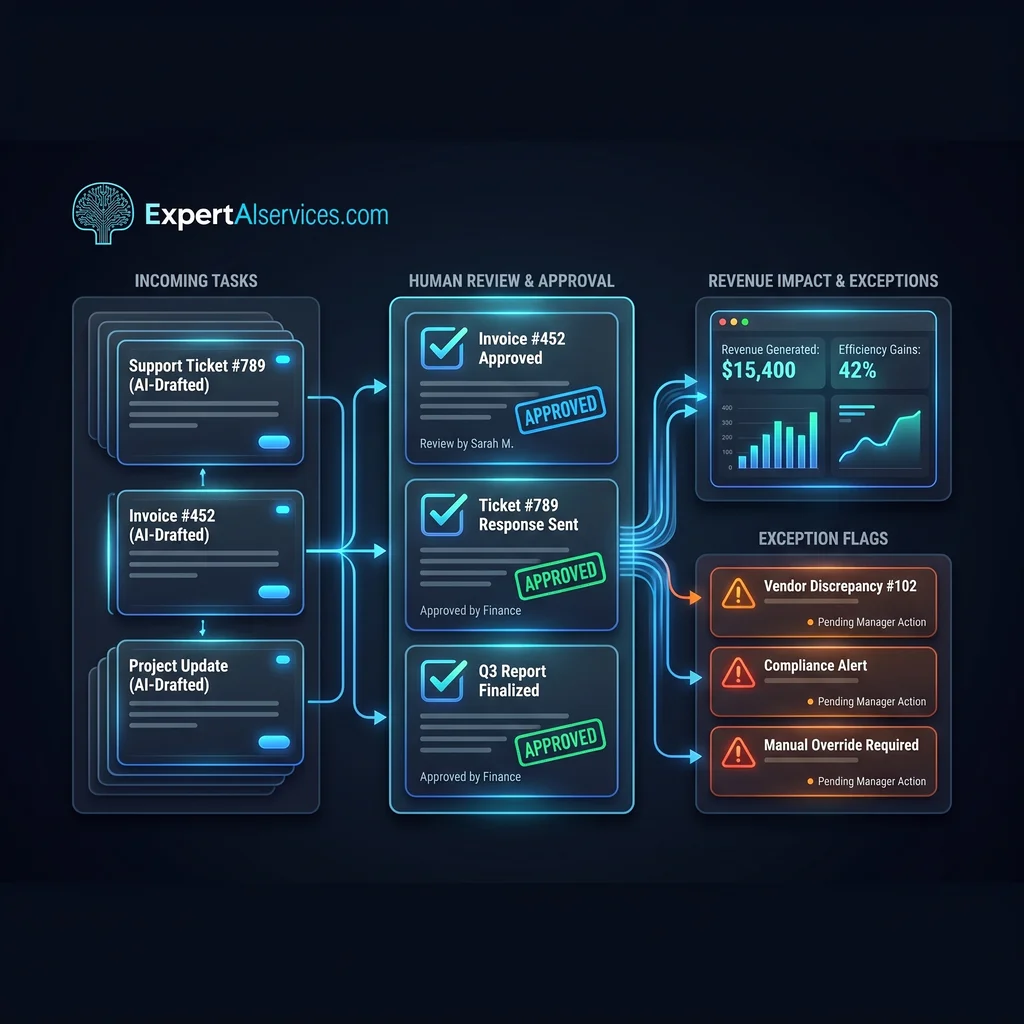
Public AI-run business experiments are becoming useful because they show the gap between automation talk and operating reality. For Kansas owners, the point is not to copy every tool or hand the company over to an agent. The better lesson is simpler: AI can prepare more work, faster, when people keep control of judgment, approvals, and customer-impacting decisions.
This AI agent business case study uses a public AI-run business experiment as teaching material, not as a client claim. The source does not give Kansas-specific results or verified revenue numbers for Expert AI Services, so the useful angle is the operating model. Owners can study where AI helps, where it needs supervision, and what should remain firmly human.
The loudest AI stories often focus on autonomy. Operators should look at the quieter part: what work can be prepared by AI and then reviewed by a responsible person. That is where small businesses are more likely to see practical value.
In the public experiment, the useful pattern is a split between AI execution tasks and owner-level judgment. AI can draft, research, summarize, organize, and document. The owner still decides what is worth doing, what should be changed, and what should never reach a customer without review.
AI becomes more useful when it is treated as operating support, not as a substitute for ownership.
That distinction matters for local companies that run on trust. A customer may never care which model drafted a message or organized a task list. They will care if the business sounds careless, misses context, or makes a decision no one is willing to stand behind.
The safest place to begin AI business automation is the work that already follows a pattern. Think meeting notes, internal research, first-draft emails, task summaries, status updates, and repeatable documentation. These jobs take time, but they can be checked against known facts.
AI agents are good at turning scattered inputs into a cleaner starting point. An owner can feed in notes, a customer request, a process outline, or a backlog of tasks. The AI can draft the next version, flag missing details, and suggest the next steps.
That does not mean the first draft is the final answer. It means the team starts from something structured instead of a blank page. For a busy Kansas operator, that difference can be the practical win: less manual logging, less tool switching, and fewer small tasks slipping through the cracks.
The public experiment also shows what should stay under human control. Strategy, pricing, brand taste, hiring judgment, customer exceptions, and major pivots need a responsible person. AI can offer options, but the business has to own the decision.
This is where human in the loop AI stops being a slogan and becomes a rule. Every workflow needs a named reviewer, a clear approval point, and a way to mark exceptions. If no one owns the review, the automation is not ready for real operations.
An AI operations case study is only useful if it changes how work is designed. The review step should not be an afterthought. It should be visible in the workflow, just like the input and the output.
A practical setup starts with five questions. What triggers the AI task? What source material is allowed? What should the AI produce? Who reviews it? What happens when the output is wrong, incomplete, or sensitive?
Those questions protect the business from overtrusting the system. They also make the automation easier to improve. When a reviewer knows what to check, mistakes become process feedback instead of silent risk.
Kansas operators do not need hype. They need systems that respect how work actually gets done. That usually means smaller automations that remove manual toil, support communication, and keep the team moving without burying people in more software.
Expert AI Services approaches that work with a local-first mindset. The team behind Expert AI Services focuses on custom AI services that fit the business, not generic tools dropped into a workflow with no ownership model. The practical goal is less software, more useful workflows.
That same discipline shows up in applied products such as SMSai, where automation supports communication while the business keeps control of how it is used. The lesson carries over to AI agents and model-agnostic stacks: automate the repeatable parts, keep the judgment close, and make review easy to audit.
The best AI-run business lesson is not that AI should run your business. It is that AI can help run the repeatable work around the business when people set the boundaries. That is a more durable way to think about AI business automation.
Start with one workflow that already costs time. Define the input, the draft output, the reviewer, and the approval rule. Then measure whether the process saves time, reduces manual rework, or improves coordination between people.
That is the kind of AI agent business case study worth copying. It is practical, reviewable, and honest about what software can and cannot own.
Client Type
Public AI-run business experiment
The Problem
Operators want automation gains without handing strategy, taste, or customer-impacting decisions fully to AI
The Solution
Use AI for drafting, research, documentation, and coordination while reserving approvals and pivots for humans
Result
Clearer separation between AI execution tasks and owner-level judgment
Result
Result
Conclusion